

































How Can Heat Transfer Roller Printing Equipment Balance Stable Mass Production with Energy Conservation and Reduced Consumption?
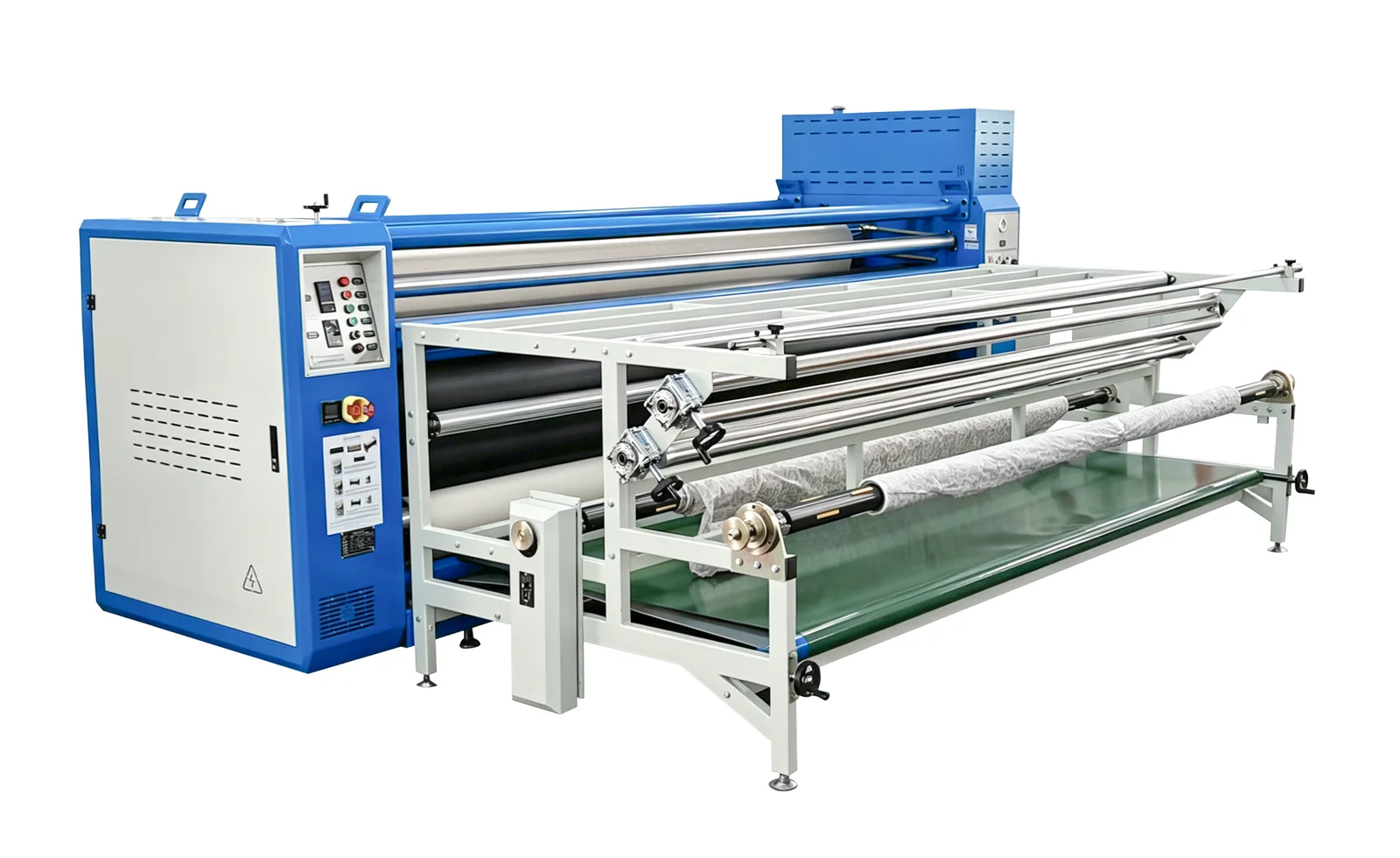
For companies that print on synthetic fiber fabrics, the value of heat transfer roller printing equipment lies not in its nominal speed, but in its ability to operate continuously and stably—with consistent color accuracy, controllable energy consumption, and minimal downtime.If equipment selection and process configuration focus solely on peak speed, mass production often comes at the expense of stability and operational costs.
I. Temperature Uniformity Is the First Hurdle to Stable Mass Production
The uniformity of the roller’s surface temperature directly determines the consistency of the transfer rate. Roller wall thickness, heating method, heat transfer oil circulation, and the placement of temperature control points all affect actual temperature variations.A common issue in mass production is that while color variation is normal immediately after startup, the edges begin to appear lighter after several hours of continuous operation; this is typically related to temperature uniformity and thermal compensation capability.
When selecting equipment, focus on: the temperature variation range within the effective working width, heat-up time, steady-state temperature fluctuations, and whether the temperature control system supports zone-by-zone monitoring.
II. Stable Tension Determines Smooth Operation
From unwinding, fabric feeding, and heat transfer to rewinding, tension fluctuations at every step can accumulate to cause wrinkles, misalignment, or crease marks.Constant-tension unwinding, automatic edge alignment, and synchronized rewinding are the key configurations that transform “running” into “smooth operation.” For fabrics with significant variations in basis weight, it is also necessary to allow sufficient tension adjustment margin within the process window.
III. Where to Achieve Energy Savings and Reduced Consumption
- Insulation Design: The insulation design of rollers and piping directly affects heat loss, and the difference is significant during long-term continuous production.
- Waste Heat Utilization: Proper heat recovery and piping layout can reduce energy consumption per unit.
- Drive Efficiency: Servo drives combined with optimal mechanical gear ratios can reduce energy losses during no-load operation and acceleration/deceleration.
- Reducing Downtime: Stable tension and temperature control reduce the frequency of fabric threading and machine adjustments, which in itself is the most direct way to save energy.
IV. Selection Recommendations: Calculate the Overall Cost First, Then Compare Specifications
When evaluating equipment, calculate the overall costs by considering daily planned output, commonly used fabrics, pattern types, and shift schedules together: energy consumption per unit of output, job changeover time, maintenance intervals, and the cost of wear-and-tear parts often determine the return on investment more effectively than the rated speed.
Established in 2003, Zhishang Technology specializes in the R&D and manufacturing of heat transfer roller printing equipment and supporting production lines. Our equipment has been exported to 83 countries and regions. If you are evaluating solutions for continuous mass production, please feel free to send us details regarding your fabric, design, and production capacity requirements. We will provide equipment configuration recommendations tailored to your specific production process.