

































Rotary Heat Press vs Flat Heat Press: How to Choose
There is a common misconception in the heat transfer industry: treating roller heat press machines and flatbed heat press machines as “different sizes of the same type of equipment.” This understanding is incorrect. Flatbed heat press machines operate on a “single-piece basis”—you place one T-shirt, press it once, remove it, and then place the next one.Roller heat press machines operate on a “continuous production” basis—fabric rolls go in at one end and come out as finished products at the other. In terms of structure, production capacity, suitable materials, and order scenarios, the two are practically worlds apart. Choosing the wrong machine isn’t just a matter of efficiency—it’s a matter of whether it can even be used.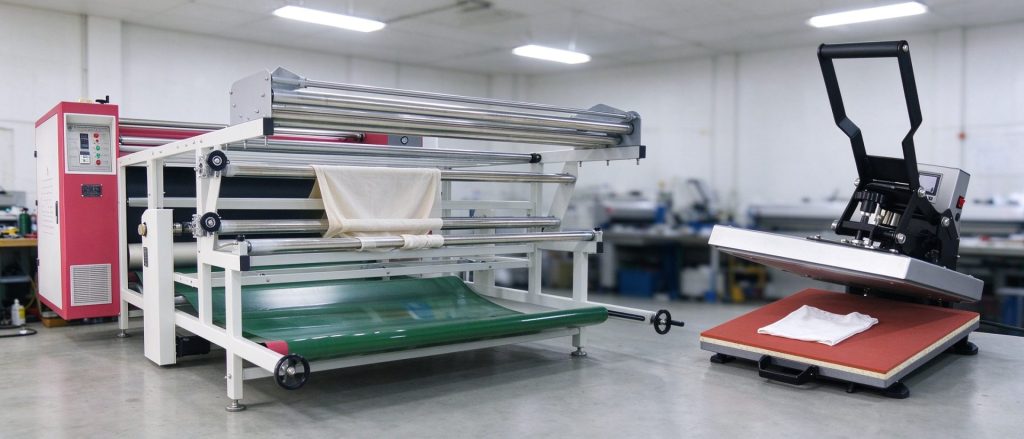
A Table to Understand the Core Differences
| Comparison Criteria | Roll-to-Roll Heat Press | Flatbed Heat Press |
|---|---|---|
| Operating Method | Roll-to-roll continuous transfer; fabric and paper pass through the rollers simultaneously | Single-piece operation: feeding, heat pressing, and unloading each item individually |
| Suitable Fabrics | Dye-sublimation transfer; suitable for polyester and synthetic/blended fabrics containing at least 50% polyester (not suitable for 100% cotton, silk, or linen) | Compatible with DTF Film or cutting film; suitable for cotton, linen, synthetic fibers, and blended fabrics |
| Suitable Products | Sportswear fabrics, flags, bedding, curtains, woven ribbons, and other roll goods | Finished products such as T-shirts, hoodies, canvas bags, hats, and throw pillows |
| Daily Production Capacity | Small machines: up to 40 m/h; mainstream models: 90–620 m/h; large machines: 880–2,000 m/h (approximately 320–16,000 meters per day based on an 8-hour shift) | Manual models: approx. 20–50 pieces; pneumatic dual-station models: approx. 50–150 pieces; fully Automatic 4 Station models: over 200 pieces |
| Temperature uniformity | Temperature difference on the drum surface within ±2°C | Temperature difference across heating plates: ±10°C (typical) |
| Investment Threshold | Entry-level models: approximately 4,400–5,300 USD | Manual models start at approximately 135 USD; pneumatic dual-station models start at approximately 530 USD |
| Space Requirements | Requires at least 10 square meters and 380V three-phase power | Standard 220V power supply; compact footprint |
| Ideal Applications | High-volume, continuous production of polyester rolls | Cotton finished goods, small-batch, high-variety production, and personalized customization |
Special note regarding fabric compatibility with roller heat press machines: The sublimation process is primarily used for polyester, but is not limited to 100% pure polyester—the higher the polyester content, the better the print vibrancy and color fastness.The table above provides a quick reference by fabric type. Data for flatbed heat press machines is based on mainstream 2026 market prices: manual flatbed (38×38 cm) approximately 135 USD, with a daily output of 20–50 pieces;pneumatic single-station models cost approximately 200–270 USD, with a daily output of 30–50 pieces; pneumatic dual-station models cost approximately 530 USD, with a daily output of 50–150 pieces.The production capacity of a roller heat press is determined by both the roller diameter and the production speed: small machines (200 mm roller) have a maximum capacity of approximately 40 m/h; mainstream models range from 90 to 620 m/h; and large machines can reach 880 to 2,000 m/h.The larger the drum diameter and the longer the contact path, the higher the speed can be increased while ensuring sufficient dye penetration.
Drum Heat Press: An Industrial Solution for Continuous Roll-to-Roll Production
The core principleof drum heat press machinesis thermal sublimation.Disperse dyes exist on the transfer paper in the form of micron-sized particles; at approximately 200°C, they vaporize directly from the solid state, bypassing the liquid phase, and sublimate into individual nanoscale dye molecules capable of penetrating the intermolecular gaps in polyester fibers.At high temperatures, the molecular chains of polyester fibers transition from a glassy state to a rubbery state, forming numerous temporary intermolecular gaps. Once the temperature drops, the fiber molecular chains return to a dense arrangement, permanently locking the dye inside the fibers.There is virtually no difference in hand feel between the printed and unprinted areas—this is what the industry refers to as “zero-feel” printing. During operation, the fabric and transfer paper are unwound simultaneously and pass continuously between the heated cylinder and the ring-shaped felt. The cylinder is heated by thermal oil, with stainless steel heating tubes directly heating the oil. The hot oil circulates within the cylinder, ensuring rapid heating and uniform surface temperature, with temperature variations typically controlled within ±2°C.Double-layer cylinders consume more electricity than single-layer cylinders, but they offer higher daily output and lower energy consumption per unit of production. Cylinder diameter is the key indicator determining production capacity. The larger the diameter, the longer the contact path between the fabric and the cylinder, allowing for higher rotational speeds while ensuring sufficient dye penetration.In the domestic market, entry-level industrial standard models cost approximately 4,400–5,300 USD and feature a drum diameter of 210 mm, making them suitable for small-scale workshops. Mid-range fully automatic models cost approximately 6,700–10,800 USD, with drum diameters ranging from 600 to 1,800 mm. The applications of drum printing machines are very specific: high-volume roll-stock orders such as flags, bedding, sportswear fabrics, curtains, and woven ribbons. They print directly onto the fabric itself, which is then cut and sewn after printing, rather than processing finished garments directly.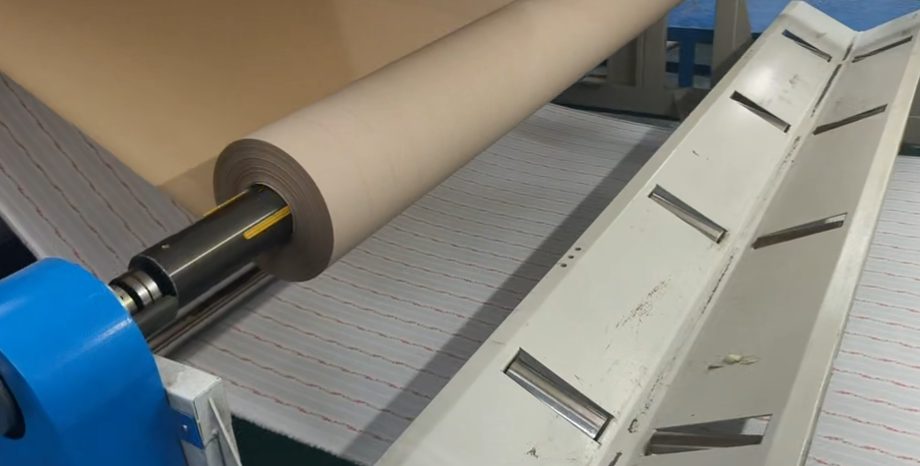
Flatbed Heat Press: A Flexible Tool for Processing Individual Garments
The operating principleof a flatbed heat pressis more intuitive: place transfer paper or transfer film onto the fabric, press down with the heating plate, hold it at a set temperature and pressure for a specific duration, then lift the heating plate and peel off the transfer paper—leaving the design on the fabric. The advantage of flatbed machines lies in their fabric compatibility and product flexibility. When used with DTF Film or lettering film, they can handle cotton, linen, synthetic fibers, and blended fabrics—unlike rotary machines, which are limited to high-polyester fabrics.Temperature control range: Manual models 0–210°C; pneumatic and fully automatic models 0–399°C (0–399°C is the upper limit of the thermostat’s range; actual common transfer temperatures are approximately 150–200°C),Time control: 0–999 seconds; parameters can be flexibly adjusted according to different fabrics and transfer materials. Flatbed heat press machines come in a wide variety of configurations. Manual models are operated by manually pressing a handle; they have the simplest structure and the lowest price. The 38×38 cm size is known as the “golden size,” as it perfectly covers the front design of an adult T-shirt, with a daily output of 20–50 pieces.Pneumatic models use compressed air to drive cylinders for automatic pressing, providing uniform and controllable pressure. Their dual-station design allows Station A to perform heat transfer while Station B loads materials, resulting in efficiency more than twice that of a single-station machine, with a daily output of 50–150 pieces.The four-station fully automatic model can process four items simultaneously, with a production capacity roughly equivalent to four standard single-station heat transfer machines. It is designed for contract manufacturers handling daily volumes of 200 items or more. Flatbed machines also have their limitations. They operate on a “single-piece-at-a-time” basis, with each item requiring a cycle of loading, heat pressing, and unloading, necessitating the operator’s involvement throughout the process.Once daily output exceeds a certain threshold, the scrap rate begins to rise due to operator fatigue. Furthermore, they cannot process roll materials; if you need to print on a full bolt of fabric, flatbed machines are simply not up to the task.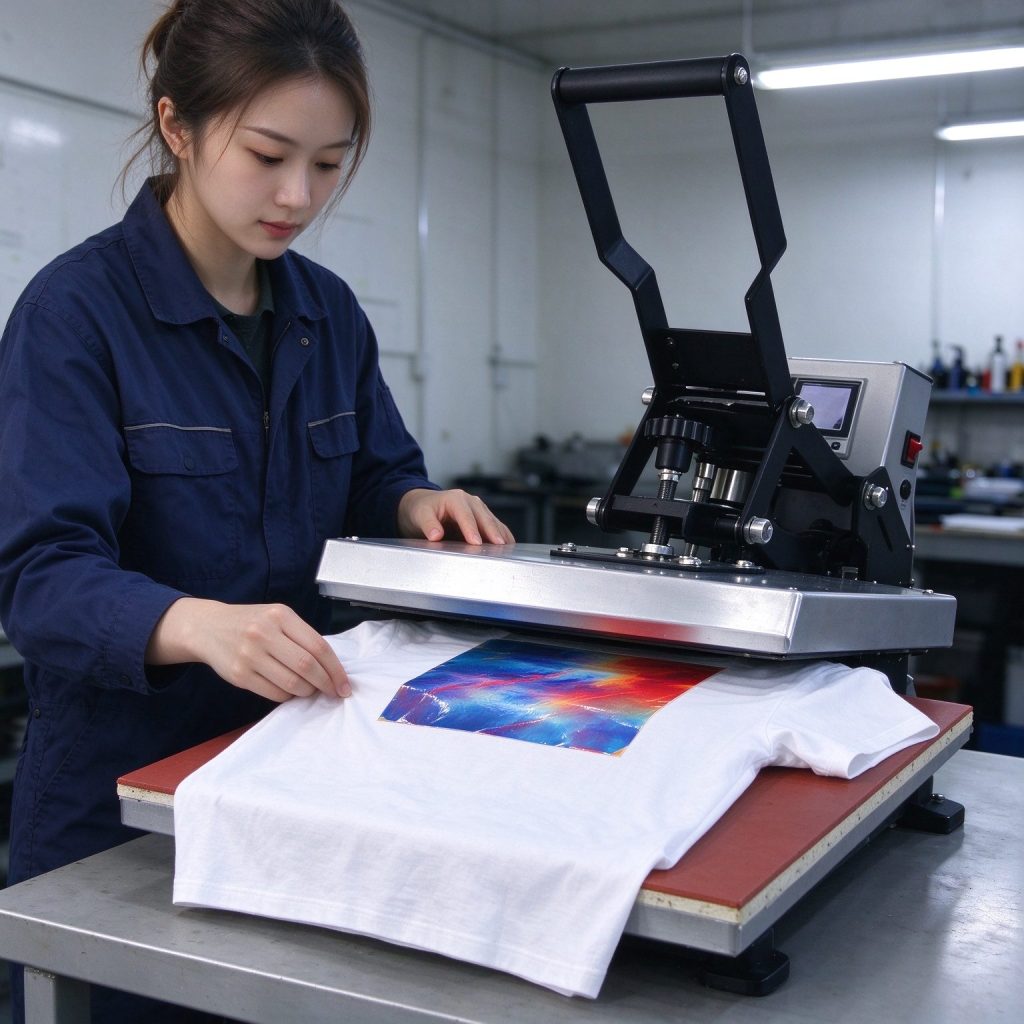
Make Decisions Based on Order Structure
Choose a roller heat press if your situation is as follows:
- Your fabrics consist primarily of polyester or high-polyester-blend rolls, with a polyester content of 50% or more (excluding pure cotton, silk, and linen)
- Orders involve continuous production of the same pattern ranging from hundreds to thousands of meters
- Your products include sportswear fabrics, flags, bedding, curtains, and woven ribbons
- You are seeking an extremely low cost per meter and zero-hand-feel quality for high-volume production
- You have access to 380V three-phase power and a production space of at least 10 square meters (two-phase power options are also available)
Choose a flatbed heat press if your situation is as follows:
- Your fabric types include cotton, blends, polyester, and others, with varying proportions
- Your orders consist of small batches, a wide variety of products, and frequently changing styles
- You produce finished products such as T-shirts, hoodies, canvas bags, hats, etc.
- You want a single machine that can handle almost all fabric and product types
- You’re starting out as a small workshop with a limited budget and limited space
If you handle both types of orders,the industry standard is to run two production lines in parallel: a drum heat press handles high-volume, continuous production of polyester rolls, while a flatbed heat press handles small-batch, flexible production of cotton garments. The two complement each other, covering nearly all heat transfer needs.For detailed specifications of both machines, please visit the product pages forthe ZS-BA Roller Heat Press and the ZS-SY Manual Heat Press.
Before making a purchase, there are three essential steps to take
First, bring your actual materials to the site for sample testing. The weight per square meter of polyester fabric and the thickness of cotton fabric will both affect the transfer results. Roller and flatbed machines may perform completely differently on the same material—you won’t know until you test them with your own materials.This is especially true for blended fabrics: different polyester content ratios can lead to significant differences in the vibrancy and colorfastness of transfers produced by roller presses. Second, calculate your average daily order volume. There is a break-even point for roller-type machines in terms of cost-effectiveness—only with an average daily volume of 500 pieces or more, or large-volume roll orders, can the efficiency advantages of roller-type machines be fully realized. Below this volume, flatbed machines are actually more cost-effective.A drum printer has a daily production capacity of 1,500 meters. If you only have 200 meters of orders per day, the machine will be idling most of the time, yet depreciation and labor costs will still accrue. Third, confirm your facility space and electrical conditions. A drum-type machine requires 380V three-phase power and, due to its heavy weight, needs a floor capable of supporting the load. A flatbed machine typically operates on standard 220V power, has a small footprint, and is suitable for workshops with limited space.
Frequently Asked Questions
Can a drum heat press print on 100% cotton T-shirts?
No. Drum heat press machines operate on the principle of thermal sublimation, and disperse dyes primarily bond with polyester fibers. Pure cotton fabrics lack sufficient chemical bonding sites to bind with the dyes, so the print will fade after just a few washes.However, blended fabrics containing 50% or more polyester can be sublimated, and the higher the polyester content, the better the results. For cotton products, use a flatbed heat press in combination with DTF transfer film or lettering film.
Can a flatbed heat press print an entire roll of fabric?
No. A flatbed heat press processes one piece at a time—it can only handle a single cut piece or finished garment per cycle. To print on an entire roll of fabric, you must use a roller heat press.
How big is the price difference between the two types of equipment?
The difference is significant. Manual flatbed heat press machines start at around 135 USD, while pneumatic dual-station models start at around 530 USD.Entry-level roller heat press machines cost approximately 4,400–5,300 USD, while medium-sized fully automatic models range from 6,700 to 10,800 USD. The initial investment for a roller heat press is about ten times that of a flatbed heat press, but the cost per meter is significantly lower for high-volume production.
Can a roller heat press and a flatbed heat press share the same set of transfer materials?
No. Drum-type machines use sublimation transfer paper, while flatbed heat press machines use DTF transfer film or lettering film; the materials are completely different and cannot be used interchangeably.
Summary
Roller heat press machines and flatbed heat transfer machines represent two parallel technological approaches, each serving different order scenarios.Fabric composition and product form are the primary decision-making factors—choose a roller machine for high-volume production of polyester and high-polyester-blend roll goods, and a flatbed machine for cotton finished goods and small-batch, multi-variety production. Based on this, evaluate order volume, facility conditions, and investment budget, and the choice will become very clear.