




























Sublimation Drum Printing vs. DTF Transfer Printing: How to Choose? A Chart to Help You Understand the Differences
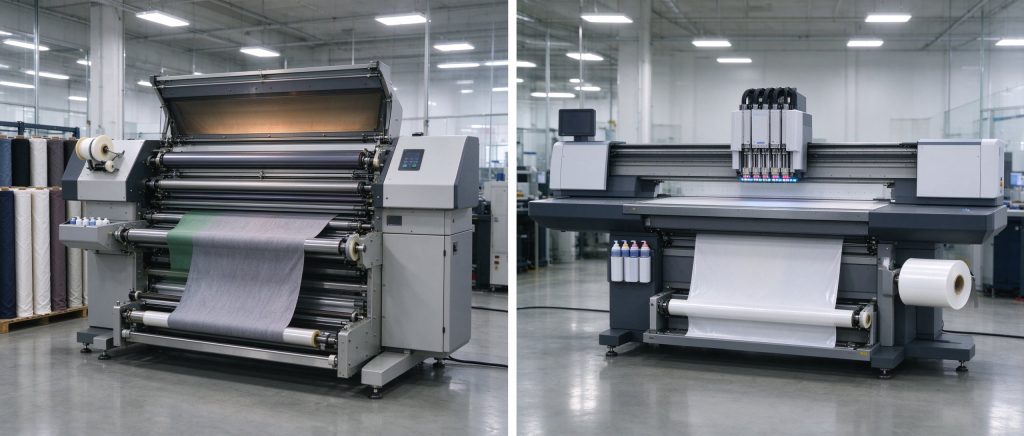
Sublimation drum printing andDTF heat transfer printingare the two mainstream technologies in the apparel printing industry today. Neither is inherently better or worse than the other; the difference lies in fabric compatibility and order structure. Below, we’ll use a table to provide a quick overview, then break down the key differences point by point.
Understanding the Core Differences at a Glance
| Comparison Criteria | Sublimation Roller Printing | DTF Transfer Printing |
|---|---|---|
| Working Principle | Disperse dyes are vaporized at high temperatures (180–230°C) inside the drum and penetrate into the interior of the polyester fibers to bond with them | The design is printed onto a PET film; after applying powder and curing, it is heat-pressed onto the fabric surface |
| Fabric Requirements | A polyester content of at least 65% is required for consistent results; fabrics with less than 50% polyester are not recommended | Cotton, polyester, blends, nylon, canvas, and other fabrics are virtually unrestricted |
| Dark-colored fabrics | Cannot be used (dye is transparent; no white ink available) | Fully supported (white ink undercoat ensures vibrant colors) |
| Textural Feel | No texture—the dye blends into the fibers, making it completely imperceptible to the touch | Film-like texture (40–80 microns); small designs are virtually imperceptible |
| Production Capacity | Roll-to-roll continuous production; approximately 4–5 meters per minute on a 600 mm roller | Sheet-to-sheet transfer: approximately 20–40 pieces per hour on industrial-grade machines |
| Investment Threshold | Entry-level models start at approximately 32,000 yuan | Complete entry-level set: approximately $1,500–$6,000 |
| Ideal Applications | High-volume production of high-polyester roll goods | Cotton garments, dark-colored clothing, small batches with multiple varieties |
Sublimation Roller Printing: A Continuous Production Solution for High-Polyester Roll Stock
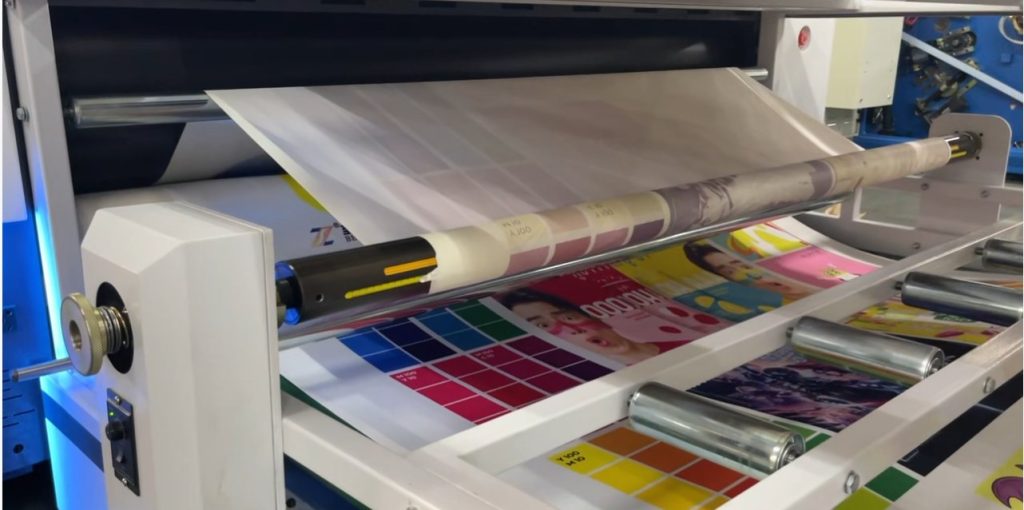
Sublimation roller printing uses “roll-to-roll” continuous transfer.The transfer paper and polyester fabric are fed simultaneously between the heated cylinder and the felt; at high temperatures of 180–230°C, disperse dyes vaporize directly from a solid state, penetrate the interior of the polyester fibers, and then solidify again.The entire process requires no water and is listed in the National Key Industries Clean Production Technology Guidance Catalog.
The core component of the equipment is the cylinder, with diameters ranging from 210 mm to 800 mm and widths ranging from 1.2 meters to over 2.5 meters. The larger the cylinder diameter, the longer the contact arc length, allowing for higher rotational speeds while ensuring sufficient dye penetration.Taking a 600-mm drum as an example, the digital paper feed speed is approximately 4–5 meters per minute. Based on an estimated effective working time of 8 hours and a comprehensive efficiency of 70%, the daily production capacity is approximately 1,300–1,700 meters.
Core Advantages
-
Extremely high efficiency for large-volume production; precise PLC-controlled temperature and speed ensure minimal color variation between batches
-
No change in fabric feel, no color fading; the dye penetrates deep into the fibers and will not crack or peel off
-
Ready-to-use upon printing; no washing or drying required; short process with low energy consumption
-
Virtually no water usage; no wastewater discharge
Main Limitations
-
Clear fabric requirements: Results deteriorate when the polyester content is below 65%; results are unacceptable below 50%; 100% cotton cannot be used directly
-
Cannot print on white or dark-colored substrates; the dye is semi-transparent
-
Can only print on rolls of fabric; cannot process finished garments such as T-shirts or hoodies
DTF Heat Transfer: A Flexible Production Solution Compatible with All Fabrics
The DTF heat transfer process consists of four steps: printing a mirror-image design with a white ink base layer onto PET film; applyinghot-melt adhesive powderand curing it; heat-pressing the design onto the fabric; and finally peeling off the carrier film. This leaves a printed film layer approximately 40–80 micrometers thick on the fabric surface.
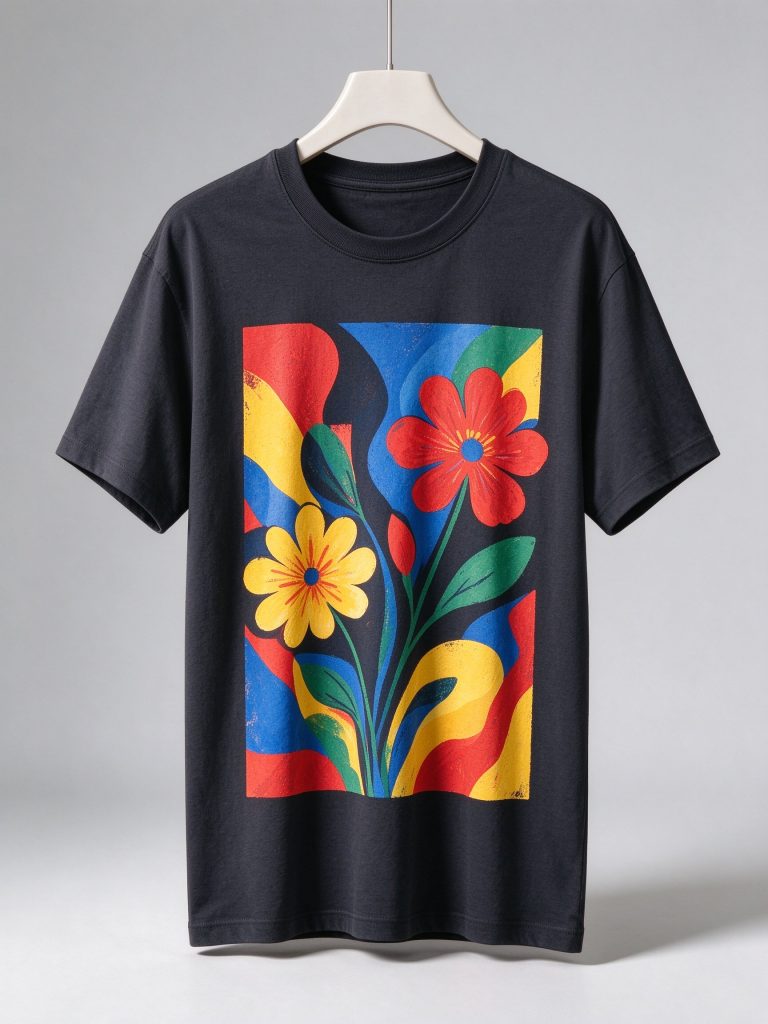
The greatest advantage of DTF is that it has virtually no fabric restrictions. It works well on cotton, polyester, blends, nylon, and canvas, and truly shines on dark-colored garments—the white ink base ensures colors remain vibrant even on black, dark blue, and other dark backgrounds.
Core Advantages
-
Versatile Fabric Compatibility: A single process covers nearly all fabric types
-
Perfect support for dark fabrics; white ink undercoating ensures color saturation
-
Transfer films can be printed and stored in advance, making them ideal for on-demand printing and scenarios with uncertain order volumes
-
No pre-treatment required, eliminating the spraying step in DTG direct-to-garment printing
Key Limitations
-
The surface has a film-like texture; large-format designs tend to feel “rubbery” to the touch
-
The process is relatively complex; powder application and curing add operational steps, and fumes are generated during curing
-
The investment in industrial-grade equipment is substantial, with a complete starter kit costing approximately $1,500–$6,000
Cost vs. Production Capacity Comparison
Cost Structure
Sublimation roller printing requires a higher initial investment.An entry-level 210mm drum model costs approximately 32,000 yuan, while a high-end industrial model of 600mm or larger ranges from 76,000 to 88,000 yuan. If daily output is less than 30 meters, the cost per meter—factoring in equipment depreciation, electricity, ink, and labor—may exceed that of contract manufacturing.
The barrier to entry for DTF is much lower. Desktop-level equipment costs approximately $1,500–$3,000, while mid-range models range from $5,000 to $8,000.The cost of transfer material per piece is approximately $0.50–$1.80, withthefilm being the largest consumable. The bulk of operating costs consists of consumables and labor; labor costs for the powder application and curing processes represent hidden expenses.
Production Capacity Logic
Sublimation roller printing follows a “line-based” production model, where fabric enters at one end and finished products exit at the other, requiring no manual intervention in between. DTF follows a “node-based” production model, where printed transfer films must be manually transported to the heat-pressing stage; while this offers high flexibility, it involves significant manual intervention.
Making Decisions Based on Order Structure
Choose dye-sublimation roller printing if:
-
The fabric is polyester or a high-polyester blend in roll form, with a polyester content of at least 65%
-
The order involves continuous production of the same pattern ranging from several hundred to several thousand meters
-
The products are sportswear fabrics, flags, bedding, curtains, etc.
-
You are seeking an extremely low cost per meter and a seamless, natural feel in high-volume production
Choose DTF heat transfer if:
-
The fabric types include cotton, blends, polyester, and others, with uncertain proportions
-
Orders are small batches with multiple varieties and frequently changing styles
-
You need to print on dark-colored or black garments
-
You produce finished products such as T-shirts, hoodies, bags, hats, etc.
Scenarios involving two parallel production lines
If an order includes both high-polyester roll stock and cotton-based finished goods, the industry standard practice is to run two production lines in parallel: sublimation roller printing handles high-volume, continuous production of high-polyester roll stock, while DTF handles small-batch, flexible production of cotton and blended finished goods.
Frequently Asked Questions
Can sublimation roll-to-roll printing be used on polyester-cotton blends?
Yes, but the results depend on the polyester content. Results are good for 65% or higher; 50%–65% is printable, though colors will be lighter and have a vintage, distressed look; below 50% is not recommended.
Can DTF heat transfer printing replace sublimation roller printing for mass production?
For orders of several thousand meters of fabric with the same design, DTF cannot compete with the efficiency and unit cost of continuous cylinder printing. However, for orders of several hundred finished garments, DTF offers significant flexibility advantages.
Is there a significant difference in hand feel between the two processes?
The difference is noticeable. Polyester fabric produced by sublimation cylinder printing has absolutely no texture; DTF has a thin, film-like feel—small patterns are barely noticeable, while large-area patterns have a distinct transfer layer that can be felt.
Summary
Sublimation roller printing and DTF heat transfer are two parallel technological approaches.Fabric composition is the primary deciding factor—choose heat sublimation roller printing for high-volume production of roll-form fabrics with a polyester content of 65% or higher, and choose DTF for cotton, blended fabrics, and dark-colored finished garments. Based on this, evaluate order volume, texture requirements, and investment budget, and the choice will become very clear.