

































Large-format Fabric Laser Cutting Machine
Equipment Model:DF Series / DF-1610 through DF-2030
The Large-format Fabric Laser Cutting Machine utilizes industrial camera-based vision positioning and a CO₂ laser with water cooling. It features a repeatability of ±0.05 mm and a working area ranging from 1600 × 1000 to 2000 × 3000 mm. with selectable laser power ranging from 80 to 300 W. It supports drawing formats such as DWG, DXF, AI, and CDR, and is suitable for cutting cycling apparel, sportswear, swimwear, home textiles, footwear, lace, luggage, automotive seat cushions, and leather goods.
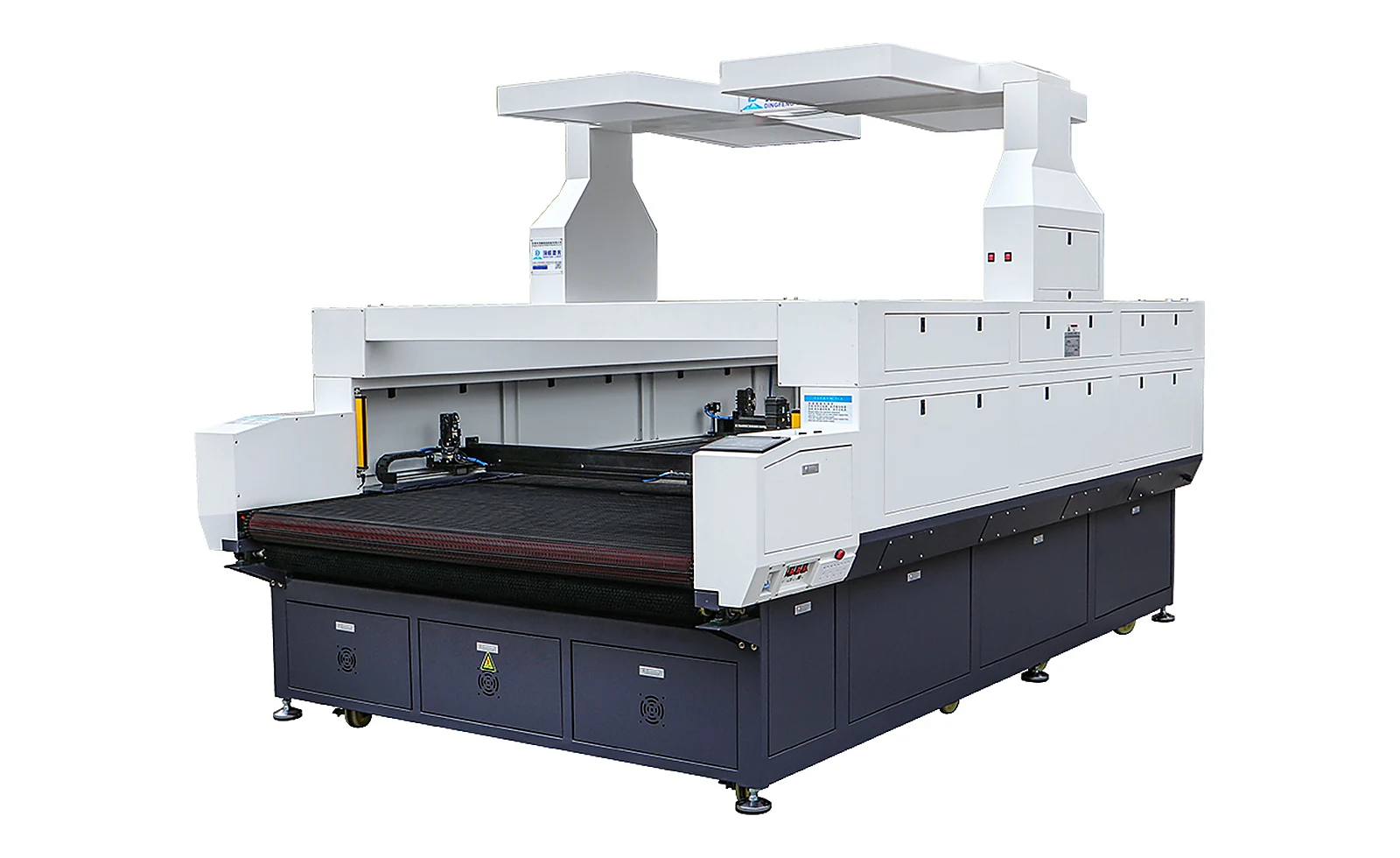 Fabric Laser Cutting Machine
Designing Equipment to Meet Actual Production Goals
The large-format Fabric Laser Cutting Machine utilizes an industrial camera-based panoramic vision recognition system and a CO₂ laser for cutting and engraving applications in apparel fabrics, home textiles, footwear materials, luggage, and leather goods.The equipment is available in 12 models ranging from DF-1610 to DF-2030, with working areas ranging from 1600×1000 mm to 2000×3000 mm and laser power options from 80 to 300 W.with total system power not exceeding 3,000W or 5,000W. The machines feature water-cooling and stepper/servo motor drives, with a repeatability accuracy of ±0.05mm. They support common drawing formats such as DWG, DXF, AI, and CDR, and allow file transfer via USB cable, USB flash drive, or Ethernet cable.
Equipment Advantages
- Large-format Vision Recognition and Positioning:The machine is equipped with an industrial camera that, in conjunction with a panoramic vision system, identifies and positions printed patterns, textures, and contours on fabric. This is ideal for processing scenarios requiring cutting along pattern contours on pre-printed or patterned fabric, reducing the need for manual alignment and tracing.
- CO₂ Laser Cutting and Engraving:Utilizing a CO₂ laser, the machine performs both fabric cutting and surface engraving. Laser power ranges from 80 to 300 W, selectable by model, to accommodate fabrics and sheet materials of varying thicknesses and materials.
- Water-Cooled System, Suitable for Continuous Processing:The entire machine utilizes a water-cooling system, with an operating temperature range of 0–45°C and an operating humidity range of 5%–95%, making it suitable for long-term, continuous cutting operations in a workshop environment.
- Repeatability of ±0.05 mm:With a repeatability of up to ±0.05 mm, combined with a stepper/servo motor drive system, this helps ensure consistent dimensions for batch-cut pieces and reduces the need for secondary trimming.
- Optional large-format worktables:Twelve worktable sizes are available, ranging from 1600 × 1000 mm to 2000 × 3000 mm. Users can select the appropriate size based on cut piece dimensions, nesting patterns, and single-shift output to minimize the need for panel assembly and material changes.
- Multiple drawing formats and transfer methods:Supports DWG, DXF, AI, CDR, PLT, BMP, JPG, TIFF, GIF, and other formats. Files can be transferred via a USB cable connected to a computer, a USB flash drive, or an Ethernet cable, facilitating seamless integration with existing layout and pattern-making workflows.
Applicable Industries and Use Cases
This machine is suitable for industries such as cycling apparel, sportswear, swimwear, dancewear, printed garments, home textiles, footwear, lace, handbags, gloves, luggage,car seat cushions, leather goods, plush fabric toys, and paper products. It can be used for fabric cutting, pattern contour cutting, lace and trim cutting, shoe material cutting, cutting of components for luggage and car seat cushions, leather goods cutting, and die-cutting of paper products.For fabrics with printed patterns or textures, the machine can first use visual recognition to align the pattern before cutting along the contour; prior to mass production, it is recommended to create samples using the actual fabric to verify the cut quality, the condition of the fused edges, and the nesting layout.
Technical Specifications
| Item | Parameter |
|---|---|
| Laser Type | Carbon Dioxide (CO₂) |
| Camera Brand | Industrial Camera |
| Cooling Method | Water-cooled |
| Repeatability | ±0.05 mm |
| Drive Type | Stepper / Servo Motor |
| Operating Voltage | 220 V / 110 V, 50/60 Hz |
| Machine Operating Temperature | 0°C–45°C |
| Operating Humidity | 5%–95% |
| Supported Image Formats | DWG, DXF, AI, CDR, PLT, BMP, JPG, TIFF, GIF |
| File Transfer Methods | USB cable to computer, USB flash drive, Ethernet cable |
Model Specifications
| Machine Model | Working Area | Laser Power (Optional) | Total Power | Cutting / Engraving Speed |
|---|---|---|---|---|
| DF-1610 | 1600×1000 | 80–150 W | ≤3,000 | 0–1,000 / 0–1,500 |
| DF-1814 | 1800×1400 | 80–150 W | ≤3,000 | 0–1,000 / 0–1,500 |
| DF-1816 | 1800×1600 | 80–150 W | ≤3,000 | 0–1,000 / 0–1,500 |
| DF-1820 | 1800×2000 | 130–300 W | ≤5,000 | 0–1,000 / 0–1,500 |
| DF-1825 | 1800 × 2500 | 150–300 W | ≤5,000 | 0–1,000 / 0–1,500 |
| DF-1830 | 1800×3000 | 150–300 W | ≤5,000 | 0–1,000 / 0–1,500 |
| DF-1916 | 1900×1600 | 150–300 W | ≤5,000 | 0–1,000 / 0–1,500 |
| DF-1922 | 1900×2200 | 150–300 W | ≤5,000 | 0–1,000 / 0–1,500 |
| DF-1927 | 1900 × 2700 | 150–300 W | ≤5,000 | 0–1,000 / 0–1,500 |
| DF-2022 | 2000×2200 | 150–300 W | ≤5,000 | 0–1,000 / 0–1,500 |
| DF-2025 | 2000 × 2500 | 150–300 W | ≤5,000 | 0–1,000 / 0–1,500 |
| DF-2030 | 2000×3000 | 150–300 W | ≤5,000 | 0–1,000 / 0–1,500 |
Note:The above specifications are for reference only for standard configurations. Working dimensions, laser power, total machine power, drive method, and vision system configuration may be adjusted based on the actual fabric, cut piece dimensions, and customization requirements. Final specifications are subject to technical confirmation and the contract.
Operating and Safety Instructions
CO₂ lasers are intense, invisible or barely visible lasers. It is strictly prohibited to open the machine enclosure to observe the cutting area while the equipment is running. Laser safety goggles rated for the appropriate wavelength must be worn, and it must be confirmed that the enclosure interlock, emergency stop button, and warning signs are in proper working order.Smoke, dust, and odors are generated during processing. Keep the exhaust and filtration systems operating normally and ensure proper workshop ventilation. Regularly inspect the water-cooling system for water temperature, water level, and pipe seals to prevent laser power degradation or component damage caused by insufficient cooling.The equipment must be reliably grounded. In workshops with significant power supply and voltage fluctuations, it is recommended to install a voltage stabilizer. After changing the fabric or adjusting the material feed method, perform a test cut on a small sample first to confirm the focal length, power, speed, and cut quality before proceeding to mass production. After shutting down the machine, clean any debris remaining on the worktable and perform routine maintenance as specified in the manual.
Selection Recommendations
When selecting a machine, first confirm the maximum outer dimensions of a single fabric piece and the nesting layout. It is recommended to allow a 100–200 mm margin beyond the maximum fabric piece size for nesting and clamping;At the same time, verify the fabric type, thickness, whether it features a printed pattern, and whether registration cutting is required to determine if industrial camera-based vision alignment is necessary.Regarding power, configurations of 80–150 W are suitable for standard thin fabrics and paper products, while configurations of 130–300 W or 150–300 W are recommended for thicker fabrics, multi-layer cutting, and engraving applications.Additionally, confirm the workshop voltage, ventilation and fume extraction conditions, water-cooling facilities, and equipment feed pathways; if necessary, provide actual fabric samples and cutting diagrams for test cutting and verification.
Applications
Large-format Fabric Laser Cutting Machines are suitable for cutting and engraving processes in industries such as apparel, home textiles, footwear, luggage, automotive interiors, toys, and paper products. They can be used for cutting fabric pieces for cycling apparel, sportswear, swimwear, dancewear, and printed clothing, as well as for pattern cutting of home textile fabrics,cutting lace and trimmings, cutting shoe materials and uppers, cutting panels for handbags, gloves, and luggage, cutting automotive seat cushions, cutting leather goods, cutting plush fabric toys, and die-cutting paper products.The combination of industrial camera vision positioning and a large-format worktable is suitable for small-to-medium-batch and mass production scenarios that require contour cutting on patterned fabrics and demand consistency in cut piece dimensions.
To confirm the working dimensions, laser power, vision positioning method, and fume extraction and cooling configurations of the large-format Fabric Laser Cutting Machine, please refer tothe Fabric Laser Cutting Machine Product Categoriesor viewthe Fabric Laser Cutting Machine Delivery and Process Commissioning Case Studies. You may alsocontact usfor model selection recommendations, fabric test cuts, and quotation proposals.
Configured for stable mass production
- Industrial Camera Large-format Vision Recognition and Positioning
- CO₂ Laser, Integrated Cutting and Engraving
- Water-Cooled System, Suitable for Long-Term Continuous Processing
- Repeatability ±0.05 mm
- Stepper/Servo Motor Drive
- Working Area: 1600×1000 to 2000×3000 mm (12 specifications available)
- Laser Power: 80–300 W (selectable by model)
- Supports DWG, DXF, AI, CDR, and other drawing formats
- Three file transfer methods: USB, flash drive, and Ethernet cable
Matching Processes to Material Properties
Expand Modules According to Production Line Requirements
Frequently Asked Questions About “Fabric Laser Cutting Machine”
12 Does laser cutting fabric cause singed edges or yellowing?
Synthetic fabrics like polyester are cut using heat, which melts the edges to seal them and prevent fraying; natural fibers like cotton and linen tend to carbonize and turn yellow.… Read the full answer
13 What is the maximum cutting size for wide-format models?
The DF series of wide-format printers includes models ranging from the DF-1610 to the DF-2030; select a model based on your layout dimensions. For continuous production with roll-f… Read the full answer
14 How do I choose between a vibrating blade and a laser?
Vibratory cutting is a cold-cutting process, suitable for heat-sensitive materials that cannot be carbonized (such as composites, leather, TPU, etc.); laser cutting is a thermal cu… Read the full answer
15 What are the differences between an automatic feed laser cutting machine and a standard model?
Automatic feed models can feed and cut simultaneously, making them suitable for mass production of fabric on rolls; standard models are suitable for cut pieces, prototyping, and sm… Read the full answer
16 What is a roller-bed die-cutting machine used for?
Primarily performs contour cutting and half-cut or full-cut die-cutting of roll materials, such as crystal labels, heat-transfer graphics, adhesive labels, and magnetic stickers; f… Read the full answer
Inquire about the detailed specifications for this device
Please provide us with the material, roll width, speed, and target production capacity, and our engineers will evaluate the equipment configuration and delivery time.
- One-on-One Engineer Evaluation
- Configuration Plan Based on Materials and Production Capacity
- We will respond within one business day
You can also contact us directly
- Email [email protected]
- Phone +86 13713137075
- WhatsApp +86 13713137075