

































How long does it take to recoup the cost of a sublimation drum transfer machine?
For peoplebuying a heat sublimation drum transfer machine, there’s one question on everyone’s mind: How long will it take to recoup the cost of the machine?
There’s no standard answer to this question. Some recoup their investment in three months, while others are still struggling to break even after two years. The difference doesn’t lie in the machine itself, but in your order mix, product pricing, and local cost levels. By breaking down the costs item by item and calculating production capacity step by step, you’ll be able to determine your own payback period.
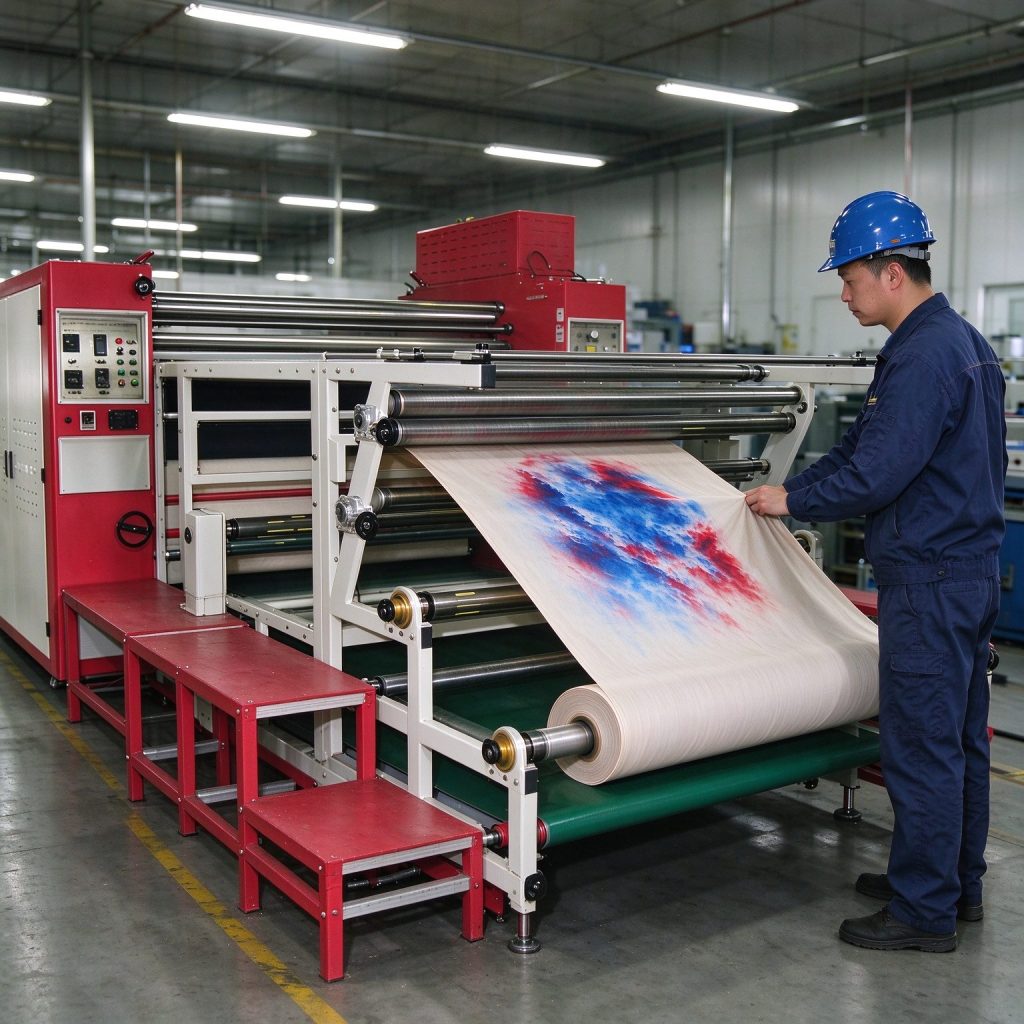
First, let’s clarify: where do the costs go?
The operating costs of a sublimation drum transfer machine fall into five major categories: equipment depreciation, electricity, ink, transfer paper, and labor. Each of these is directly related to what you print, how much you print, and the country where you operate.
Equipment depreciation is the biggest expense. An entry-level machine costs 27,000 yuan (about $3,750); using straight-line depreciation over three years, the monthly depreciation is about $104. A mid-range machine costs 67,000 yuan (about $9,300), with a monthly depreciation of about $258.A high-end machine costs 133,000 yuan (approximately $18,500), with a monthly depreciation of about $514. If depreciated over five years, the entry-level machine costs only $63 per month. A drum-type machine can typically operate without issues for five to eight years, and the blanket needs to be replaced every one to two years.
Electricity costsare the second-largest expense. Drum dryers rely on thermal oil for heating, and their actual electricity consumption is approximately 40% to 60% of the rated power.Electricity prices vary significantly by region. Based on rough figures from official statistics in various countries: industrial electricity rates in the U.S. are approximately $0.08 to $0.09 per kWh (according to the U.S. Energy Information Administration, EIA); non-residential electricity rates in the EU are approximately $0.20 to $0.23 per kWh (according to Eurostat);prices vary by province in China, with industrial list prices generally ranging from 0.6 to 0.8 yuan per kWh, equivalent to approximately $0.08 to $0.11. Electricity costs in Europe are more than double those in the U.S., and in countries with high electricity prices like Germany, they are even higher.
Ink and transfer paperare variable costs; the more you print, the greater the consumption. Forink, there are two options: domestically produced wholesale ink and original brand-name ink, with a price difference of more than tenfold. The same applies totransfer paper, where the gap between wholesale and brand-name prices is significant.
Laborcosts vary the most (the figures below represent approximate levels based on current public statistics; actual costs depend on local wages).In the U.S., heat press operators earn $18 to $25 per hour; in the U.K., annual salaries range from approximately $30,000 to $37,000; in Germany, hourly wages range from $16 to $22; in Vietnam, monthly salaries range from $315 to $395; and in China, monthly salaries range from approximately $700 to $1,100.Even when operating the same machine, the labor cost per meter in Vietnam is only one-fifth of that in the U.S.
Three tiers of equipment, with completely different cost structures
Sublimation drum transfer machines on the market are generally divided into three tiers. The table below lists actual configurations currently available for sale; both prices and print sizes are accurate.
| Comparison Criteria | Entry-Level (200 × 1300 mm) | Mid-Range (610×1800 mm) | High-End (1000×2000 mm) |
|---|---|---|---|
| Equipment Price | 27,000 yuan (approx. $3,750) | 67,000 yuan (approx. $9,300) | 133,000 yuan (approx. $18,500) |
| Maximum Sheet Size | 200 × 1,300 mm | 610 × 1,800 mm | 1,000 × 2,000 mm |
| Average Daily Production Capacity | 30–50 meters | 100–300 meters | Over 300 meters |
| Monthly depreciation (3 years) | Approx. $104 | Approx. $258 | Approx. $514 |
| Guidance and Separation | Standard alignment and separation devices | Standard alignment and separation devices | Fully automatic web guiding and separation |
| Heating Method | Oil-Temperature Heating | Double-layer oil heating | Double-layer oil-heated system |
| Manual | 1 person per machine | 1 person per machine | 1 person can manage 2 units |
| Suitable for | Small workshops, custom curtains | Small and medium-sized printing factories | Large-scale factories, export orders |
The entry-level model features a print area of 200 × 1,300 mm. Although this is the smallest configuration, it comes standard with edge-guidance and fabric-separation mechanisms. This means operators do not need to frequently adjust the fabric edges manually during operation, and the paper and fabric are automatically separated after transfer. As a result, a single operator can manage one machine, significantly increasing efficiency compared to older models without edge-guidance and fabric-separation features.The medium-sized machine has a working area of 610×1800 mm. Its dual-layer rollers consume 20% to 30% less power than single-layer models, making it suitable for daily order volumes of 100 to 300 meters.The high-end model has a print area of 1000×2000 mm and is equipped with fully automatic web guiding and separation systems. It is suitable for large-scale factories with daily order volumes exceeding 300 meters. For export orders, please also refer tothe precautions for equipment export and delivery.
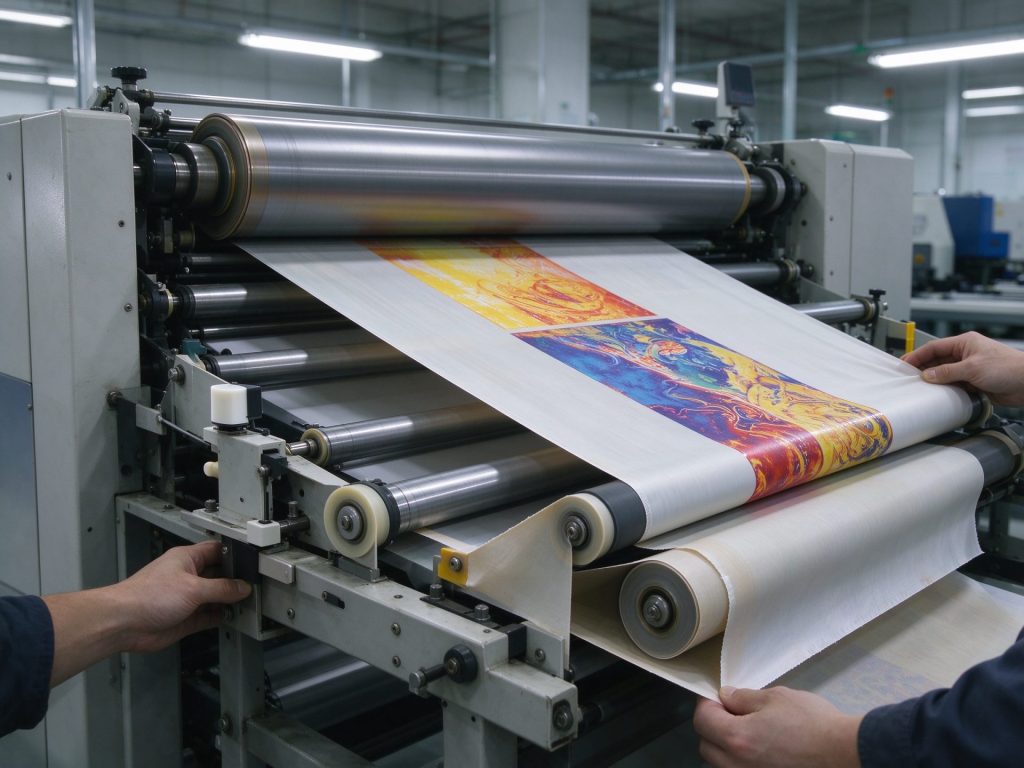
What is the actual cost per meter? Calculated by region
Taking an entry-level 200×1300 mm drum printer as an example, with an average daily output of 50 meters and 22 working days per month (based on European and American standards), the monthly output is 1,100 meters.Consumables are calculated based on domestic wholesale prices: ink at $0.01 per milliliter, transfer paper at $0.15 per square meter, with a roll width of 1.3 meters.
Fixed Costs (Monthly): Equipment depreciation: $104 ($3,750 over 3 years).
Variable costs (per meter):
-
Electricity: Based on daily consumption of 80 kWh and approximately 1.6 kWh per meter, the cost is about $0.14 per meter in the U.S. (at $0.085/kWh) and about $0.34 per meter in Europe (at $0.21/kWh).
-
Ink: 10 milliliters of ink consumed per square meter; at $0.01 per milliliter, this amounts to $0.13 per meter.
-
Transfer paper: $0.15 per square meter, or $0.20 per meter.
-
Labor: See the table below.
Labor costs calculated by region(based on labor cost per meter):
| Region | Hourly Wage | Labor Cost per Meter | Total Cost per Meter (including local electricity rates) |
|---|---|---|---|
| United States | $18–$25 | $0.15–$0.21 | $0.62–$0.68 |
| United Kingdom | Approx. $15–$18 per hour | $0.13–$0.15 | $0.60–$0.62 |
| Germany | $16–22 per hour | $0.13–$0.18 | $0.66–$0.76 (based on German electricity rates) |
| China | Approx. $4–$6 per hour | $0.03–$0.05 | $0.50–$0.52 |
| Vietnam | Approx. $2 per hour | $0.02 | $0.49 |
If you use original brand-name ink (approximately $0.10 per milliliter), the cost of ink per meter rises to $1.30, and the total cost will double. The choice of ink brand is the biggest variable in cost control.
By comparison, the market price for heat-sublimation transfer printing through a contract manufacturer ranges from about $4 to $10 per meter for small batches of 50 meters, and can drop below $3 per meter for large batches of 1,000 meters or more. If your order volume is small, printing in-house may indeed be more expensive than outsourcing.
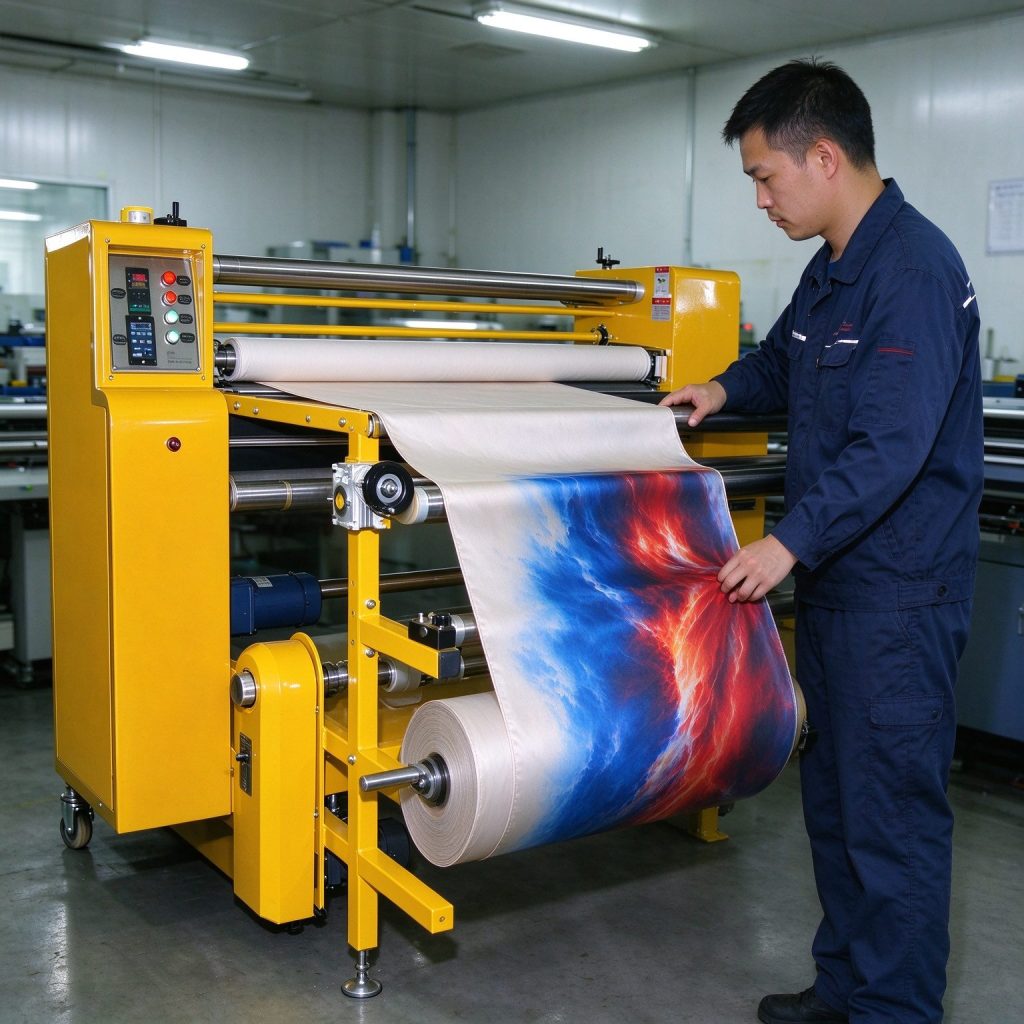
Production Capacity Determines Efficiency; Efficiency Determines Cost
Print width and roller diameter are the key factors determining production capacity. The wider the print width, the wider the area that can be printed in a single pass, resulting in higher output per unit of time.
| Equipment Model | Transfer Speed | Daily Production Capacity (8 hours, 70% efficiency) |
|---|---|---|
| 200 × 1300 mm | Approx. 1.5–2 meters/minute | Approx. 500–670 meters |
| 610 × 1,800 mm | Approx. 2.5–3.5 meters/minute | Approx. 840–1,180 meters |
| 1000 × 2000 mm | Approx. 4–5 meters/minute | Approx. 1,340–1,680 meters |
However, these production capacities are theoretical values. In actual production, time is lost due to job changes, temperature adjustments, paper changes, and troubleshooting. It is prudent to estimate based on an overall efficiency of 70%. It is important to distinguish between two things: the 500–1,680 meters listed in the table above represent the maximum production capacity calculated based on the machine running at full capacity for 8 hours;how many orders you can actually fill each day is a separate matter. For most small processing plants, an entry-level machine running 30 to 50 meters per day, a mid-range machine running 100 to 300 meters, and a high-end machine running over 300 meters is already considered stable.
The key question is: Can your orders fully utilize this production capacity? If a high-spec machine has a daily production capacity of 1,500 meters but you only have 200 meters of orders per day, the machine will be idling most of the time. Depreciation and labor costs will still accrue, so the cost per meter won’t go down.
Payback Period: Real-World Calculations for Two Scenarios
Scenario 1: Developed Countries (U.S./Europe), Average Daily Orders of 50 Meters
Equipment: Entry-level 200×1300mm model, investment of $3,750. Assuming orders can consistently fill 50 meters per day; with a five-day workweek in Europe and the U.S. and 22 working days per month, monthly output is 1,100 meters.At a selling price of $8 per meter, monthly revenue is $8,800; material costs (ink, transfer paper, electricity) are $0.65 per meter, totaling $715, plus $104 in depreciation.
Labor costs are the key factor. Producing 50 meters per day actually only requires one or two hours of machine operation. In most small workshops, the owner operates the machine themselves, resulting in a monthly labor cost of approximately $819 and a monthly net profit of about $7,981, allowing the equipment cost to be recouped in roughly two weeks;If a full-time operator is hired (based on a U.S. hourly wage of $20, 8 hours per day, and 22 days per month—monthly labor costs would be about $3,520; labor costs in Europe are even higher), monthly costs would be about $4,339, with a monthly net profit of about $4,461, and the investment would be recouped in about three to four weeks.
If the product has higher added value and sells for $15 per meter, monthly revenue would be $16,500. Even with an operator, the monthly net profit would be approximately $12,161, and the investment would pay off in less than two weeks.
Scenario 2: Developing Countries (Southeast Asia/China), Average Daily Orders of 150 Meters
Select a medium-sized machine (610 × 1,800 mm) with an investment of $9,300. In Southeast Asia and China, operations typically run six days a week. Assuming 25 working days per month, an average daily output of 150 meters results in a monthly production of 3,750 meters;At a selling price of $6 per meter, monthly revenue is $22,500. Material costs are $0.52 per meter, totaling $1,950; labor costs are $900 per person per month; and depreciation is $258.Total monthly costs are approximately $3,108, resulting in a monthly net profit of approximately $19,392, with a payback period of just over 2 weeks.
If the product is priced lower—at $4 per meter—monthly revenue would be $15,000, with a monthly net profit of approximately $11,892 and a payback period of about 3 weeks.
One important note: The two sets of figures above are based on an ideal scenario where “orders are fully booked, selling prices are maintained, and there is no scrap.”In real-world business, order volumes fluctuate, prototyping involves scrap, and there are factory rent and payment terms to consider. Therefore, a more realistic estimate is that—assuming stable order volume—an entry-level drum machine typically breaks even in 1 to 3 months, a mid-range machine in 3 to 8 months, and a high-end machine in half a year to over a year.If the payback period falls below this range, it indicates exceptionally favorable order volume and pricing; if it exceeds this range, the issue is likely not with the machine itself but with the order structure.
Following this line of reasoning, we recommend calculating three key figures first: how many meters of orders you can secure daily, how much you can sell each meter for, and what the cost per meter is. Multiply one figure by the other and subtract the third, and the payback period will become clear.
Factors That Can Slow Down the Payback Period
Unstable order volume.If you receive 300 meters today and 30 meters tomorrow, production capacity fluctuates wildly, and fixed costs aren’t spread evenly. Stability is more important than daily output.
Product pricing is too low.The market price for sublimation printing can be as low as under $3 per meter (for large batches). If you’re producing commoditized products, you can’t win a price war against contract manufacturers. Only differentiated products—custom designs, small batches, and fast turnaround—give you pricing power. If you’re unsure about the production process, start bydeciding between sublimation and DTF.
Hidden costs are often overlooked.Print beds need to be replaced every one to two years, and each one costs several hundred to over a thousand dollars. Scrap rates for transfer paper, sample production waste, and machine maintenance—these off-the-books costs add up significantly.
Buying the most expensive instead of the right one.Entry-level machines can get the job done for as little as $3,750 and come standard with registration control and separation, but many people are intimidated by the term “industrial-grade” and end up buying equipment far beyond their order volume. The machines are high-quality, but if you can’t utilize their full capacity, you’ll still have to absorb the depreciation costs.
Frequently Asked Questions
What’s the lowest price to get started with a heat sublimation drum transfer machine?
An entry-level 200×1300mm drum model costs about 27,000 yuan (approximately $3,750), comes standard with web guiding and separation, and is suitable for small-scale production of 30 to 50 meters per day.However, this covers only the machine itself; you’ll also need acompatible digital printer to producetransfer paper, which—along with any necessary modifications—costs approximately $800 to $1,500. The total startup budget for the entire setup is about $4,550 to $5,250.
How many meters per day do you need to print to make it profitable?
Based on an estimated total cost of $0.50 to $0.70 per meter, if you can sell your product for more than $4 per meter, a daily output of 50 meters will yield a profit. If you can only sell it for less than $3 per meter, daily production must be at least 200 meters to be cost-effective. Below this output, outsourcing production may be more economical.
Do high-end machines pay for themselves faster than entry-level models?
Not necessarily. High-end machines have higher production capacity and better automation, but they also require a larger investment. If your order volume can fully utilize its capacity, the cost per meter for a high-end machine is lower, and you’ll recoup your investment faster. However, if your order volume is only enough to run an entry-level machine, a high-end machine will actually slow down your return on investment.
Is it worth considering used equipment?
Yes, it is. Roller machines have a simple structure; the core components are the rollers, felts, and temperature control system. As long as the rollers aren’t warped and the temperature control is functioning properly, used equipment can certainly get the job done.Used machines typically cost 50 to 70 percent of the price of new ones, which significantly reduces the pressure to recoup your investment. However, before purchasing, you should test the machine on-site to check for even temperature distribution, the degree of blanket wear, and any oil leaks.
Summary
The payback period for a heat sublimation drum transfer machine depends primarily on order volume, not the machine’s price. With the same equipment, a daily output of 30 meters versus 300 meters can result in a payback period that differs by a factor of five.Before buying, carefully calculate three key figures: how many meters of orders you can secure daily, how much you can sell each meter for, and what the cost per meter is. Once you’ve calculated these three figures, the payback period will become clear. If your average daily output isn’t sufficient to cover the equipment costs, consider outsourcing production first and invest in the equipment only after your order volume has stabilized.