

































Up-sliding Dual Station Heat Press Machine
The Up-sliding Dual Station Heat Press Machine features a dual-station alternating operation and a top-slide operating mechanism, and is available in four sizes: 38×38, 40×60, 60×80, and 70×90 cm, supports 220V/110V voltages, with power ranging from 2200 to 5500 W, with a temperature range of 0–399°C and a timer range of 0–999 seconds. It is suitable for batch heat transfer printing on garment cut pieces, T-shirts, luggage, and flat products.
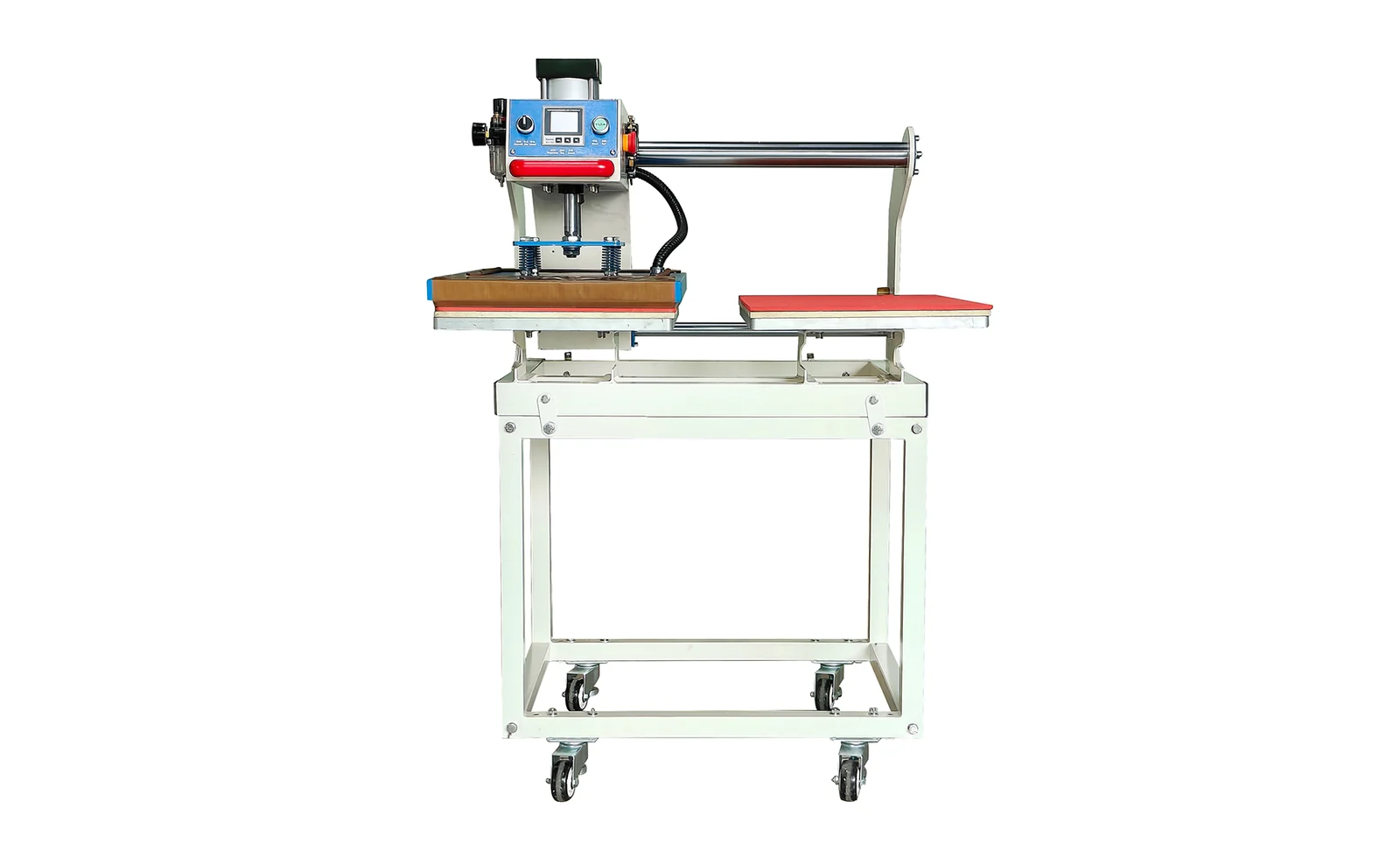 Heat Press Machine
Designing Equipment to Meet Actual Production Goals
The
top-loading dual-station heat transfer machine is a thermal transfer device designed for bulk heat pressing of finished garments, fabric cut pieces, and flat products. It features a dual-station alternating operation structure, allowing one station to be prepared while the other is in use, thereby improving continuous production efficiency.The machine is available in four sizes: 38×38 cm, 40×60 cm, 60×80 cm, and 70×90 cm. It supports 220V/110V voltages and is available in power ratings of 2200W, 2500W, 3000W, and 5500W.with a temperature range of 0–399°C and a time range of 0–999 seconds, meeting the heat transfer processing needs for various sizes and production capacities.
Equipment Advantages
- Dual-Station Alternating Operation:The dual-tray design facilitates alternating loading and heat pressing; operators can position the next product while the machine is pressing, reducing wait times and making it ideal for continuous batch production.
- Sliding Operation Mechanism:The machine head and printing platform feature a coordinated sliding movement design, enabling intuitive station switching and facilitating quick positioning, loading, and unloading of garment cut pieces, T-shirts, and flat products.
- Wide Temperature Control (0–399°C):The temperature setting range covers the requirements of common DTF Films, heat transfers, and heat pressing processes, and can be adjusted based on fabric thickness, transfer media, and design requirements.
- 0–999 s precise timing:Pressing time can be set via the digital panel, facilitating consistent process cycles during batch production and reducing errors caused by manual timing.
- Multiple Sizes and Power Options:Four printing area sizes ranging from 38×38 cm to 70×90 cm, with power options including 2200 W, 2500 W, 3000 W, and 5500 W, allowing for easy equipment selection based on product dimensions and production volume.
- Mobile, Sturdy Frame:The entire machine is mounted on a sturdy frame equipped with casters, making it easy to move and reposition within the workshop while providing stable support for continuous dual-station operation.
Applicable Industries and Use Cases
The top-sliding dual-station heat press is suitable for flat heat pressing and heat transfer on apparel fabrics such as cotton, blended fabrics, and synthetic fibers. It can also be used for processing T-shirts, hoodies, workwear, sportswear, garment cut pieces, canvas bags, luggage, throw pillows, mouse pads, and other flat products.The dual-station design is particularly well-suited for production scenarios requiring continuous feeding, batch pressing, and frequent pattern changes. Since different materials have varying temperature, pressure, and time requirements, it is recommended to conduct sample testing using the same fabric and transfer media before starting full-scale production.
Technical Specifications
| Print Area | Voltage | Power | Temperature Range | Time Range | Dimensions | Net Weight |
|---|---|---|---|---|---|---|
| 38×38 cm | 220 V / 110 V | 2200W | 0–399°C | 0–999 s | 55×70×130 cm | 75 kg |
| 40×60 cm | 220 V / 110 V | 2500W | 0–399°C | 0–999 s | 93×80×136 cm | 95 kg |
| 60×80 cm | 220 V / 110 V | 3000W | 0–399°C | 0–999 s | 170×80×140 cm | 125 kg |
| 70×90 cm | 220 V / 110 V | 5500W | 0–399°C | 0–999 s | 195×85×146 cm | 210 kg |
Note: The above specifications are for reference only for standard configurations. Voltage, power, dimensions, and weight may be adjusted based on customization requirements; final specifications are subject to technical confirmation and the contract.
Operating and Safety Instructions
The equipment uses a heating plate for pressing; the heating plate reaches high temperatures during operation. Avoid direct contact with the heated surface during operation and cleaning, and confirm that the temperature is within a safe range before loading or unloading materials. The equipment features pneumatic or electric clamping mechanisms; under no circumstances should hands be placed between the heating plate and the base during operation;Before adjusting pressure, replacing heating elements, or servicing drive components, the machine must be shut down and the pressure released. The equipment must be reliably grounded; keep the power cord away from heating components, and keep the control box dry and clean. Routinely inspect the heating elements, temperature control display, pneumatic or electric mechanisms, and emergency stop button as specified in the manual. If abnormal temperatures, air leaks, or unusual sounds are detected, shut down the machine immediately for inspection and repair. This machine has a power rating of 2200 / 2500 / 3000 / 5500 W. Before wiring, verify that the workshop’s power capacity meets the requirements.
Model Selection Recommendations
For standard T-shirts, sweatshirts, and small-to-medium-sized fabric pieces, prioritize the 38×38 cm or 40×60 cm sizes; when covering large garment pieces, combined patterns, or larger luggage fabric pieces, select the 60×80 cm or 70×90 cm sizes.Dual-station machines are suitable for applications requiring continuous heat pressing. When selecting a model, evaluate common product sizes, daily output, number of operators, workshop power capacity, and available floor space to ensure the appropriate power rating and station layout.
Applications
This machine can be used for processing flat products such as garment heat transfer printing, DTF Film pressing, T-shirt customization, sweatshirt printing, workwear processing, sportswear pattern transfer, canvas bag production, pressing of luggage and bag fabric pieces, and transfers on throw pillows and mouse pads.The dual-station alternating production method helps reduce loading and unloading wait times, making it suitable for small-batch, high-variety production and medium-batch continuous production.
To confirm the specifications, power, voltage, and station layout of the sliding-type dual-station heat press, please refer tothe heat press product categories, or view theZS-SY manual heat press.You can alsocontact usfor model selection advice, sample testing, and pricing proposals.
Related Equipment and Resources
Dual-station machines are suitable for continuous feeding and batch heat pressing. When selecting a model, you should also compare print area, power, station layout, and labor cycle time. Please refer to the following comparison of machine models and processes.
Configured for stable mass production
- Dual-station alternating operation reduces loading and unloading wait times
- Sliding-type operating mechanism allows for intuitive station switching
- Four sizes available: 38×38, 40×60, 60×80, and 70×90 cm
- 220V/110V voltage options
- Power configurations: 2200W, 2500W, 3000W, 5500W
- Wide-range digital temperature control: 0–399°C
- Timer control: 0–999 seconds
- Sturdy frame with casters for easy movement and setup
Matching Processes to Material Properties
Expand Modules According to Production Line Requirements
Frequently Asked Questions About “Heat Press Machine”
01 Are you a manufacturer or a trading company?
We are a manufacturer of printing equipment based in Dongguan, Guangdong. Founded in 2003, we handle all aspects of our business—from research and development to precision machining, assembly, and commissioning—in our own factory. Our equipment has been exported to 83 countries and regions.
02 How do I choose between sublimation drum transfer and digital printing?
Sublimation drum transfer is suitable for continuous mass production of synthetic fabrics, offering high design fidelity, consistent colors, and low unit costs; for small-batch orders with multiple designs, digital printing may be a better option. Send us your fabric and design, and we’ll provide recommendations based on a side-by-side comparison.
03 Can we produce a sample first to verify the process?
Sure. Please send us the fabric and design, and we’ll create a sample using the appropriate machine model. We’ll provide you with parameters such as temperature, pressure, and speed, along with a sample piece of fabric. Once you’ve confirmed the transfer results, we’ll finalize the machine model.
04 Can the web width, speed, and production capacity be customized?
Yes. The web width, speed, tension control, and unwinding, web guiding, and rewinding configurations can all be adjusted according to the fabric characteristics and production capacity goals.
05 How to Choose Between Manual, Pneumatic, and Electric Heat Press Machines?
Choose based on order volume and labor costs: The manual ZS-SY model requires a small investment and is suitable for small batches with a wide variety of products; the pneumatic and electric lifting models offer stable pressure and fast cycle times, and are better suited for continuous batch production when equipped with two or four workstations.
06 What are the practical benefits of two-station and four-station setups?
While one workstation is performing heat pressing, another can load materials, making effective use of downtime and resulting in higher output and better consistency.
07 What is the difference between a single-sided, dual-station heat transfer machine and a double-sided, dual-station heat transfer machine?
Single-sided models apply the heat to one side at a time; double-sided models can complete both sides in a single pass, making them ideal for products like collar labels, woven ribbons, and socks that require designs on both sides.
08 How do I choose between a flatbed heat press and a roller transfer machine?
Flat-bed heat press machines are used for sheet materials, garment cut pieces, and finished garments; for continuous production of roll-fed fabric, roller transfer machines are used. These two processes are often used in combination.
Inquire about the detailed specifications for this device
Please provide us with the material, roll width, speed, and target production capacity, and our engineers will evaluate the equipment configuration and delivery time.
- One-on-One Engineer Evaluation
- Configuration Plan Based on Materials and Production Capacity
- We will respond within one business day
You can also contact us directly
- Email [email protected]
- Phone +86 13713137075
- WhatsApp +86 13713137075