































Automatic Electric Up-sliding Dual-station Heat Press Machine
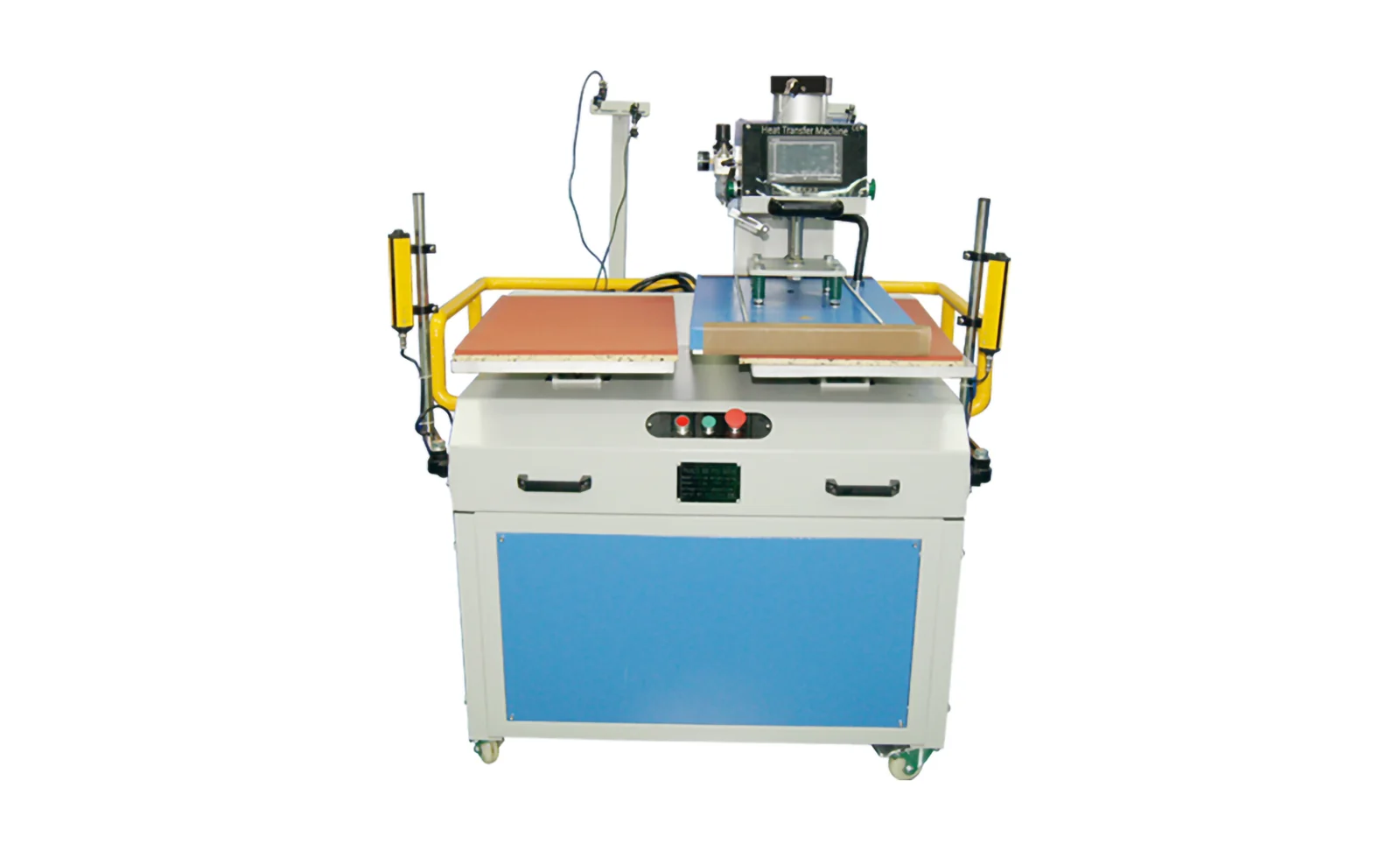
This automatic electric up-sliding Dual-station Heat Press Machine features PLC control, external pneumatic cylinders, and dual-axis linear guides. The press head automatically moves left and right and is available in the following sizes: 38×38, 40×60, 60×80, and 70×90 cm, with a power range of 2.2–5 kW. temperature range of 0–399°C, time range of 0–999 s, and pressure range of 0–8 kg/cm². It is suitable for heat transfer printing, sublimation printing, and fabric pressing.
 Heat Press Machine
Designing Equipment to Meet Actual Production Goals
The Automatic Electric Up-sliding Dual-station Heat Press Machine features a PLC-controlled system, external pneumatic cylinders, and a up-sliding dual-station design; the press head can automatically move left and right to complete the heat pressing process.The equipment is available in four sizes: 38×38 cm, 40×60 cm, 60×80 cm, and 70×90 cm, with power ratings of 2.2 kW, 3.5 kW, 3.8 kW, and 5 kW, a temperature range of 0–399°C,a time range of 0–999 s, and an operating pressure of 0–8 kg/cm²; it is suitable for heat transfer printing, sublimation digital printing, and the batch processing of various textiles and flat products.
Equipment Advantages
- PLC Electronic Control and Alarm Function:The PLC control system supports parameter settings, production counting, and alarm notifications, facilitating batch order management and monitoring of equipment operating status.
- Automatic Left-to-Right Movement of the Print Head:The print head automatically moves left and right to complete the heat pressing process. Combined with dual-station alternating loading, this reduces manual movement and waiting time during loading and unloading.
- Powerful External Cylinder Pressure:The external cylinder provides stable pressing force, with working pressure adjustable within the range of 0–8 kg/cm², accommodating materials of varying thicknesses and different heat transfer processes.
- Light Curtain Hand Protection:The machine is equipped with a light curtain safety system to reduce the risk of hands entering the pressing area during operation and enhance safety during continuous dual-station operation.
- Imported dual-axis linear guide rails:The machine features an imported dual-axis linear sliding mechanism that ensures smooth operation and excellent wear resistance, helping to maintain long-term operational stability and positioning accuracy at each station.
- Multiple Substrate Materials and Processes:Capable of processing sublimation and solvent-based ink designs, as well as processes such as heat press, foam printing, low-temperature, low-pressure interlining bonding for apparel, and bonding of shoe and hat materials.
Applicable Industries and Use Cases
This machine is suitable for heat transfer printing and hot pressing of fabrics such as cotton, linen, synthetic fibers, and nylon, as well as ceramic products. It can be used for printing on sports jerseys, T-shirts, promotional apparel, throw pillows, mug sleeves,mouse pads, pearlescent panels, soundproofing panels, and other products. It is also suitable for heat press transfers, foam printing, and low-temperature, low-pressure bonding of apparel, footwear, and headwear materials. The equipment is equally suitable for small-batch production of handkerchiefs and other flat products, supports a variety of specifications, and can be customized for non-standard sizes upon request.Since different materials have varying temperature, pressure, and time requirements, it is recommended to conduct sample testing using the same materials and transfer media before starting formal production.
Technical Specifications
| Printing Area | Voltage | Power | Temperature Range | Time Range | Operating Pressure |
|---|---|---|---|---|---|
| 38 × 38 cm | 220 V / 110 V | 2.2 kW | 0–399°C | 0–999 s | 0–8 kg/cm² |
| 40 × 60 cm | 220 V / 110 V | 3.5 kW | 0–399°C | 0–999 s | 0–8 kg/cm² |
| 60 × 80 cm | 220 V / 110 V | 3.8 kW | 0–399°C | 0–999 s | 0–8 kg/cm² |
| 70 × 90 cm | 220 V / 380 V | 5 kW | 0–399°C | 0–999 s | 0–8 kg/cm² |
Note:The above specifications are for reference purposes only for standard configurations. Voltage, power, printing area, control method, worktable configuration, and pressure range may be adjusted based on custom specifications; final specifications are subject to technical confirmation and the contract.
Operating and Safety Instructions
Before commencing full-scale production, verify that the safety light curtain, emergency stop button, air supply, pressure, temperature, and time parameters are in normal operating condition. Also, ensure that no personnel or foreign objects are present within the automatic left-to-right travel range of the print head. When changing materials or transfer media, perform a test print to confirm adhesion, color fastness, and material deformation before proceeding to mass production.
Selection Recommendations
For standard T-shirts, jerseys, throw pillows, and small-to-medium-sized fabric pieces, prioritize the 38×38 cm or 40×60 cm sizes;For processing larger garment cut pieces, promotional apparel, bag materials, or composite designs, choose the 60×80 cm or 70×90 cm sizes. When selecting a model, confirm the workshop voltage, air supply conditions, product dimensions, target output, and available installation space to ensure the appropriate power rating and dual-station layout.
Applications
This machine can be used for heat transfer printing, sublimation digital printing, pillow printing, mug sleeve printing, mouse pad printing, sports jersey heat press, promotional apparel, and T-shirt printing. It is also suitable for printing on pearlescent panels, soundproofing panels,ceramic products, flocked heat press, foam printing, and the bonding of apparel, footwear, and headwear materials. PLC electronic control, automatic counting, safety light curtain protection, and continuous dual-station operation make this machine ideal for stable orders and batch production scenarios.
To confirm the specifications, voltage, air supply, and station configuration of the Automatic Electric Up-sliding Dual-station Heat Press Machine, please viewthe Heat Press Machine categories, or reviewthe Automatic Pneumatic Up-sliding Dual-station Heat Press Machine,the Automatic Four-station Heat Press Machine, andthe Up-sliding Dual-station Heat Press Machine. You can alsocontact usfor model selection advice, sample testing, and quotation proposals.
Configured for stable mass production
- PLC programming, piece-rate counting, and alarm functions
- Automatic left-to-right movement of the head for heat pressing
- Licht curtain safety device to prevent hand pinching
- External air cylinder for powerful pressure
- Adjustable working pressure: 0–8 kg/cm²
- Imported dual-axis linear sliding mechanism
- Sliding-type dual-station continuous operation
- Four sizes: 38×38, 40×60, 60×80, and 70×90 cm
- Custom sizes available upon request
Matching Processes to Material Properties
Expand Modules According to Production Line Requirements
Frequently Asked Questions About “Heat Press Machine”
12 How to Choose Between Manual, Pneumatic, and Electric Heat Press Machines?
Choose based on order volume and labor costs: The manual ZS-SY model requires a small investment and is suitable for small batches with a wide variety of products; the pneumatic an… Read the full answer
13 What are the practical benefits of two-station and four-station setups?
While one workstation is performing heat pressing, another can load materials, making effective use of downtime and resulting in higher output and better consistency. Read the full answer
14 What is the difference between a single-sided, dual-station heat transfer machine and a double-sided, dual-station heat transfer machine?
Single-sided models apply the heat to one side at a time; double-sided models can complete both sides in a single pass, making them ideal for products like collar labels, woven rib… Read the full answer
15 How do I choose between a flatbed heat press and a roller transfer machine?
Flat-bed heat press machines are used for sheet materials, garment cut pieces, and finished garments; for continuous production of roll-fed fabric, roller transfer machines are use… Read the full answer
Inquire about the detailed specifications for this device
Please provide us with the material, roll width, speed, and target production capacity, and our engineers will evaluate the equipment configuration and delivery time.
- One-on-One Engineer Evaluation
- Configuration Plan Based on Materials and Production Capacity
- We will respond within one business day
You can also contact us directly
- Email [email protected]
- Phone +86 13713137075
- WhatsApp +86 13713137075