

































2026 Guangzhou Asia-Pacific Screen Printing Expo: Zhishang Technology Showcases Integrated Printing and Cutting Solutions
From November 18 to 20, 2026, the 48th ASGA Asia-Pacific Screen Printing and Digital Printing Exhibition was held in Zone B of the Guangzhou Canton Fair Complex.Dongguan Zhishang Technology Co., Ltd. exhibited roller heat Transfer Machines, sublimation ribbon printers, pneumatic dual-station heat transfer machines, and vibrating knife cutters. Focusing on “printing + cutting” continuous production scenarios, the company engaged in on-site discussions with buyers from domestic markets as well as Southeast Asia, the Middle East, and Eastern Europe.
As one of the leading professional screen printing and digital printing trade shows in South China, this year’s event attracted a large number of visitors. Inquiries focused primarily on equipment production capacity, material compatibility, temperature and tension control, automation configurations, export packaging, and after-sales support.Rather than comparing the specifications of individual machines, an increasing number of customers are seeking to evaluate screen printing and post-processing cutting as part of a single production workflow, thereby reducing compatibility issues between equipment and the costs associated with coordinating with multiple suppliers.
Exhibition Focus: Shifting from Individual Machine Purchases to Complete Production Processes
Zhishang Technology began trading in printing equipment and consumables in Hong Kong in 1997, collaborating directly with overseas clients and accumulating experience with fabrics, designs, and processes through actual orders; in 2003, the company opened a factory in Humen, Dongguan, transitioning from trade to in-house production; In 2009, “Dongguan Zhishang Printing Machinery Co., Ltd.” was incorporated, gradually establishing a manufacturing system covering R& D and design, precision machining, assembly and debugging, and shipping inspection; in 2019, the company was renamed “Dongguan Zhishang Technology Co., Ltd..”Currently, ZS Series roller-type heat transfer and sublimation equipment has been exported to 83 countries and regions. This exhibition goes beyond simply displaying equipment; instead, it showcases integrated solutions tailored to customers’ actual production needs—including materials, web widths, order structures, and post-processing workflows.
- Dates:November 18–20, 2026
- Location:Area B, Guangzhou Canton Fair Complex
- Booth: 10.1-D39
- Exhibition Focus:Continuous roller transfer printing, ribbon sublimation printing, dual-station heat pressing, and vibrating knife cutting
- On-site Results:Contracts signed for 2 units of equipment; additional clients are continuing discussions regarding configurations, prototyping, and delivery plans
Four Categories of Equipment Exhibited
1. ZS Series Roller Heat Transfer Machine: Designed for continuous mass production
Roll-to-roll heat transfer is suitable for the continuous processing of roll materials such as apparel fabrics, home textiles, and advertising banners.The ZS Series equipment on display is designed for stable material feeding, uniform heating, and continuous production; some configurations feature a double-layer heating structure, thermal oil circulation, PLC touchscreen control, and an automatic web guiding system.The actual available drum diameters, working widths, heating power, and winding/unwinding methods must be determined based on fabric width, pattern characteristics, and daily production capacity.
For overseas customers, the most common on-site inquiries are not limited to maximum speed, but also include temperature stability during prolonged operation, ease of job changeovers, and maintenance of wear-prone parts. Rather than simply comparing the price of a single machine, factoring in fabric, process, downtime, and waste makes it easier to determine the true unit production cost. For more configurations, please refer tothe roller-type sublimation Transfer Machine product series.
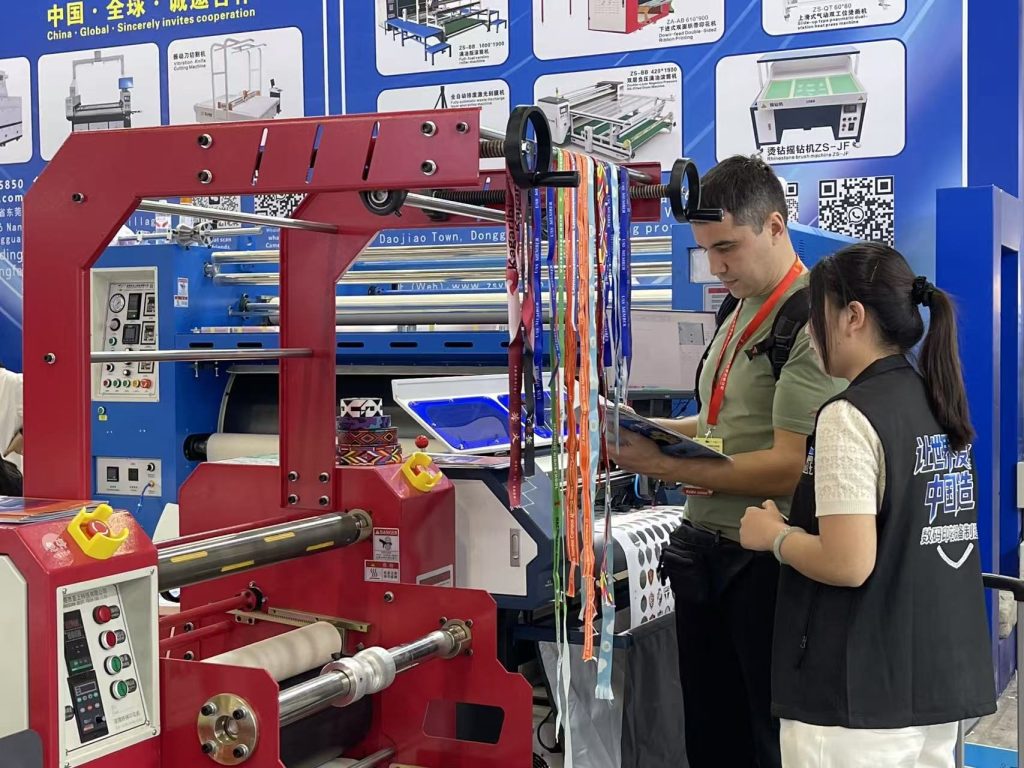
2. Pneumatic Dual-Station Heat Press: Suitable for garment pieces and small-batch, high-variety orders
The pneumatic dual-station heat press is primarily designed for garment cut pieces, sportswear, T-shirts, ready-to-wear heat-sealed labels, and flat home textile materials.Alternating loading and unloading at the two stations reduces wait times, while PLC control facilitates the setup of temperature, pressure, and time parameters. For custom apparel and small-batch, high-variety production, the speed of changeovers and operational consistency are often more important than simply pursuing a large printing area.
During on-site consultations, customers select the working area and pressure configuration based on fabric thickness, transfer media, design size, and shift schedules. For related equipment, please refer tothe heat transfer and heat press product series.
3. Sublimation Ribbon Printing Machine: Solving Misalignment and Continuous Feeding/Winding Issues for Narrow-Width Materials
Narrow-width materials—such as luggage webbing, garment elastic bands, shoelaces, lanyards, and zippers—are more susceptible to tension fluctuations, misalignment, color overlap, and uneven winding during continuous printing.The sublimation web printing machines on display feature tension control, positioning tables, and feed/take-up mechanisms to accommodate single-sided, double-sided, and multi-channel continuous printing requirements.
When selecting this type of equipment, one must not only consider web width and speed but also confirm the process by taking into account the web material, elasticity, thickness, pattern repeat, and winding method. For more models, please viewthe sublimation web printing machine product series.
4. Vibrating Blade Cutters: Cutting Flexible Materials After Printing
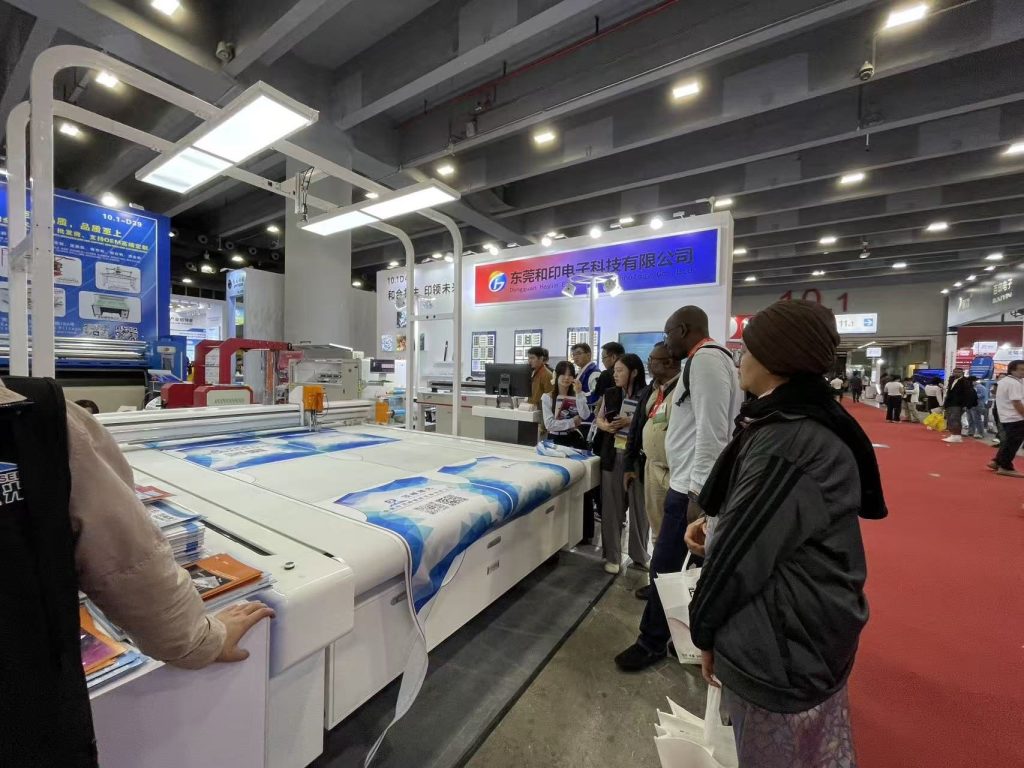
The cutting precision, layout utilization, and edge quality after printing directly impact downstream efficiency and material costs. Vibrating blade cutters can be used for flexible materials such as fabric, leather, plush, and home textile fabrics, and support configurations including automatic layout, intelligent edge detection, and multi-layer cutting.When paired with a roller Transfer Machine, the front-end printing and back-end cutting can be integrated into a single production cycle, reducing waiting time between processes and eliminating repetitive material handling.
On-site demonstrations showcased the equipment in operation and the results of material cutting. Visitors focused their attention on cutting precision, nesting software, the vacuum table, blade consumables, and parameter settings for different materials. For more details about the equipment, please visitthe vibro-knife cutting machine product page.
Technical Highlights: Temperature, Energy Consumption, and Material Utilization Must Be Assessed in Context of Operating Conditions
Temperature uniformity in roller heat transfer directly affects color consistency and defect rates.The exhibited equipment reduces temperature variations on the drum surface through dual-layer heating, thermal oil circulation, and a temperature control system; the company’s standard configuration aims to maintain surface temperature variations within approximately ±1.5°C, though actual values may vary depending on the machine model, measurement point location, heating phase, operating speed, and environmental conditions.
Regarding energy consumption, the heating structure, insulation layer, drum coverage rate, and production schedule all affect energy consumption per unit. Proper equipment configuration can reduce heat loss and idle runtime; however, specific energy-saving figures must be tested under identical conditions—same material, same design, and same output—and cannot be directly compared without considering actual operating conditions.
Material utilization for vibration knife cutting primarily depends on the pattern, fabric width, layout algorithm, and order mix. Intelligent layout helps reduce scrap, but the actual improvement varies with changes in product structure. For customers engaged in long-term mass production, it is recommended to conduct layout tests using actual orders before calculating material costs and equipment return on investment.
The “Certifications” page on our official website displays the company’s CE certifications and compliance documentation, covering specific equipment such as digital printing machines and fabric winding machines. Certificates, applicable standards, and accompanying technical documentation may vary by equipment model; for export orders, please verify the specific model and target market requirements before signing a contract. You mayview Zhishang Technology’s certification and qualification documents.
On-site Discussions: Customers Are More Concerned About Whether the Entire Process Can Be Implemented
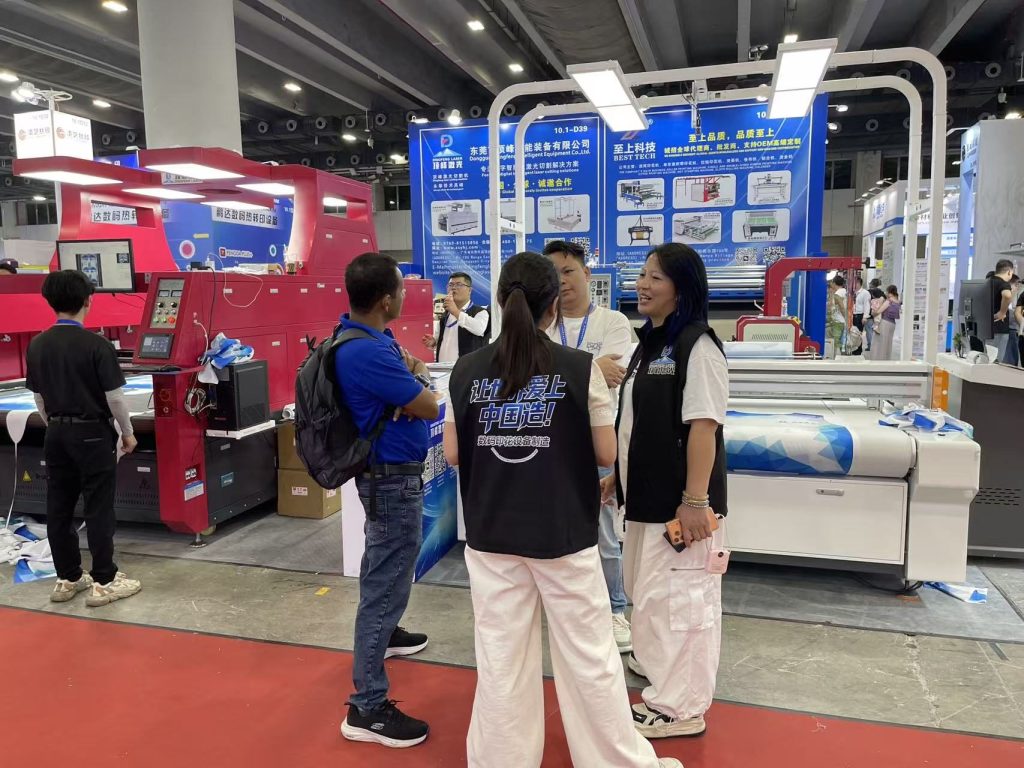
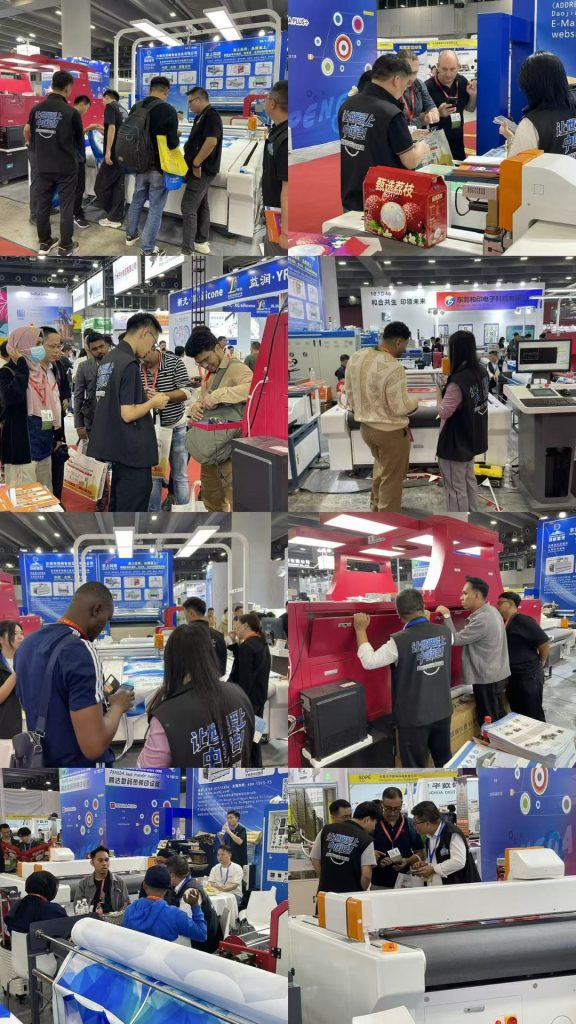
During the exhibition, visitors included garment printing factories, home textile companies, and manufacturers of luggage accessories and woven ribbons, as well as overseas buyers from markets such as Southeast Asia, the Middle East, and Eastern Europe.Overseas clients focused primarily on sublimation ribbon printing machines and oscillating blade cutters, with inquiries centered on material compatibility, production capacity calculations, voltage and plug standards, export packaging, installation training, and spare parts supply.
The on-site team provided one-on-one equipment selection recommendations based on clients’ material types, web widths, order volumes, budgets, and existing production processes. For clients in apparel accessories and luggage webbing, discussions centered on webbing printing and winding solutions; for home textile and apparel fabric clients, the focus was on integrating rotary Transfer Machines with oscillating blade cutters.
According to on-site statistics compiled by the exhibition team,two equipment contracts were signedat this event, and numerous other clients are currently finalizing samples, configurations, and delivery schedules. For Zhishang Technology, the exhibition offered more than just order leads; more importantly, it provided direct insight into the actual requirements of different markets regarding automation levels, operating practices, and after-sales response times.
Industry Trend: Integrated Printing and Cutting Is Becoming a Practical Need
Judging by the nature of inquiries at this year’s exhibition, three distinct trends are emerging in the textile processing equipment sector: First, customers are placing greater emphasis on the coordination of the entire production line—from printing to cutting—rather than comparing individual machines in isolation; second, there has been an increase in small-batch, high-variety orders, making order changeover efficiency and parameter management more critical; Third, while overseas customers remain price-conscious, they are also placing greater emphasis on certification documents, export packaging, installation training, and spare parts supply.
These changes mean that equipment suppliers must possess a comprehensive understanding of production processes, as well as the ability to configure individual machines and design integrated production lines. Rotary transfer printing, ribbon printing, and vibrating blade cutting are distinct processes, but in actual production, they collectively influence delivery lead times, material utilization, and yield rates.When selecting equipment, customers can refer tocomparisons between dye-sublimation rotary printing and DTF processes, as well asbetween rotary heat press and flatbed heat press, to first determine the process route and then compare specific machine models.
Frequently Asked Questions
What equipment did Zhishang Technology exhibit at the 2026 Guangzhou Asia-Pacific Screen Printing Exhibition?
The main exhibits at the event included the ZS Series rotary heat transfer press, sublimation ribbon printing machine, pneumatic dual-station heat press, and oscillating knife cutter, covering continuous roll printing, narrow-width ribbon printing, heat pressing of cut pieces, and post-processing cutting of flexible materials.
Can the roller heat Transfer Machine and the oscillating knife cutter be used together?
Yes. The front-end roller heat transfer machine handles roll-to-roll printing, while the rear-end oscillating blade cutter handles pattern-based cutting. The specific configuration depends on the fabric, design, width, piece dimensions, and production cycle time.
Can I send a sample first or come to the factory for prototyping?
We can arrange prototyping or test printing based on the material, target process, and production capacity requirements. We recommend providing the fabric composition, width, weight, pattern dimensions, estimated daily output, and target market to help confirm equipment configuration and testing plans.
Does CE certification cover all equipment models?
Our official website displays specific CE certification and compliance documentation; certificates apply to specific product ranges. Before exporting, you should verify the certificates and technical documents against the actual model, target country, and customer requirements; they should not be interpreted as covering all machine models.
Obtain Equipment Solutions at Trade Shows
If you are evaluating equipment for dye-sublimation roller transfer, continuous web printing, or post-printing cutting for woven ribbons, please provide material samples, web width, daily production capacity, order structure, and target market. Zhishang Technology can arrange equipment selection, prototyping, export packaging, and after-sales support based on your actual production process.
For more information, please reviewthe Zhishang Technology company brochure and product catalog, or submit your project requirements viathe Contact Us page.
Note:This article is compiled based on on-site records from the Zhishang Technology exhibition held November 18–20, 2026, as well as product materials and publicly available certifications on the company’s official website.Exhibition reception and contract signing statistics were compiled on-site by the company’s exhibition team; equipment temperature, energy consumption, and material utilization rates may vary depending on machine model, materials, process parameters, and test conditions. Specific details are subject to technical proposals, test records, and contract documents.