






























Dye-Sublimation Printer ZS1904-K
Equipment Model:ZS1904-K
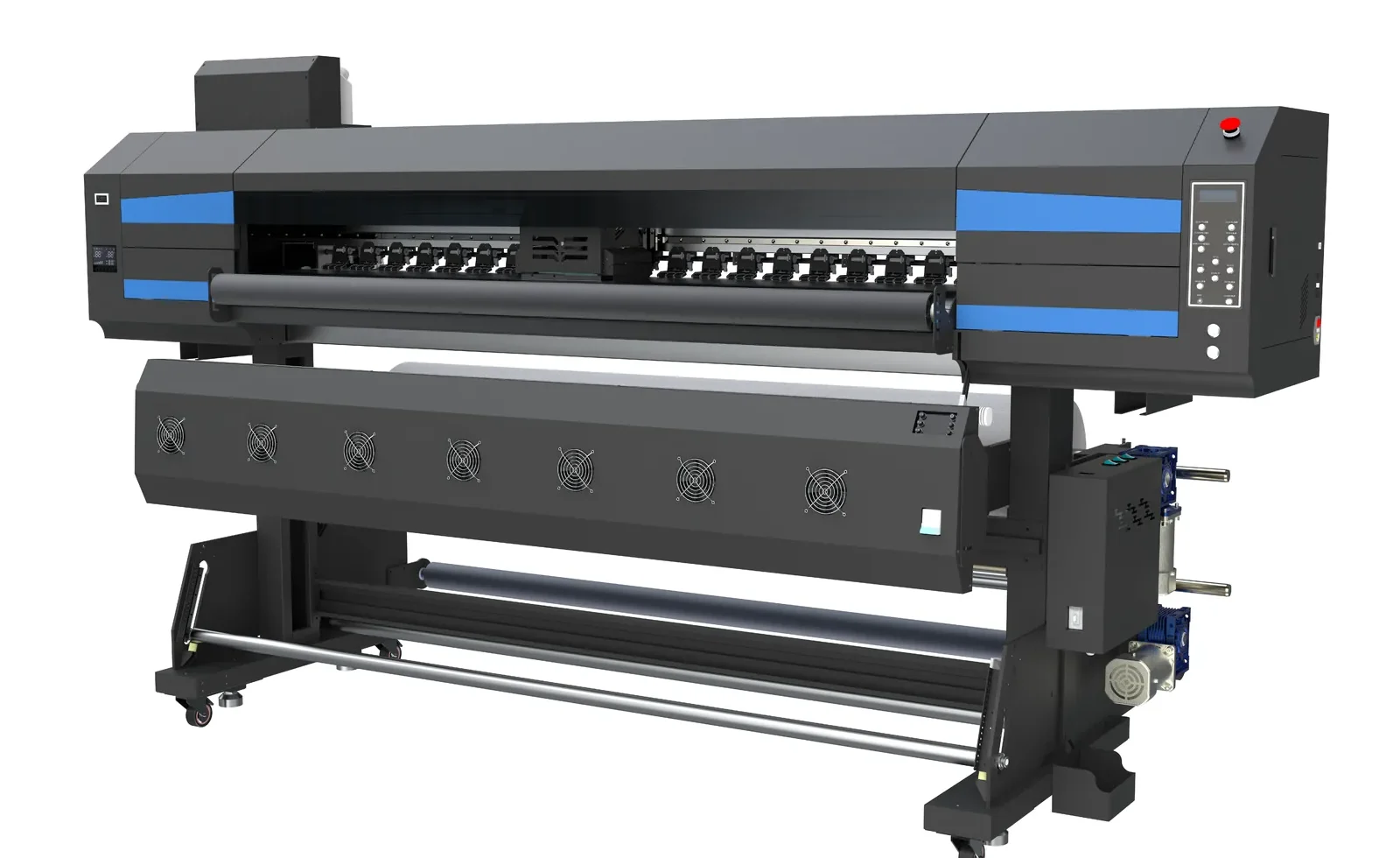
The ZS1904-K sublimation printer has a print width of 1,850 mm and is equipped with four Epson i3200 printheads. with a maximum output of 115 m²/h in 2-pass mode. It is equipped with a heavy-duty air-expandable shaft tension unwinding and rewinding system and a vacuum table designed specifically for printing, making it ideal for high-volume, continuous sublimation printing on synthetic fabrics and garment cut pieces.
 Sublimation Printer
Designing Equipment to Meet Actual Production Goals
The ZS1904-K sublimation printer is a wide-format digital sublimation printing device with a print width of 1,850 mm. It is equipped with four Epson i3200 high-precision, high-speed printheads and can achieve a maximum print speed of 115 m²/h in 2-pass mode.The machine features a heavy-duty air-tension shaft tension control system and a vacuum table designed specifically for printing, making it ideal for high-volume, continuous sublimation printing of synthetic fabrics, garment cut pieces, and other materials.
Machine Features
- Four High-Precision Print Heads:Equipped with four Epson i3200-A1 high-precision, high-speed print heads, the printer achieves a print speed of up to 115 m²/h in 2-pass high-speed mode, balancing high-speed output with print accuracy.
- Heavy-duty air-shrink shaft tension winding and unwinding system:With high load-bearing capacity and precise, stable tension control, it ensures that printed rolls are wound smoothly and unwound at a uniform speed, enhancing the quality of printed products and production efficiency.
- Imported Quiet Linear Guides:Equipped with imported THK quiet linear guides and sliders, ensuring smooth high-speed operation with low noise.
- High-Power Servo Motors:Ample power supports high-volume continuous operation.
- Multiple standard protection features:Important features such as low-ink alarm, printhead collision protection, paper-out detection, and printhead base heating are included as standard.
Details and Structure
- Dedicated Suction Platform for Printing:Ensures the media remains flat and flush during printing, reducing paper feed misalignment.
- Tension Guide Rod:Works with the winding and unwinding system to stabilize material feed tension.
- Dalian Ink Cartridge:Provides continuous ink supply, reducing the number of downtime stops required for refilling.
- Machined carriage frame:Machined construction ensures more stable precision during high-speed operation.
- Aluminum plate-style ink stack:More reliable printhead parking and humidity control.
Applications
- Printing on finished garments such as T-shirts and clothing cut pieces
- Printing on home textiles such as throw pillows and pillowcases
- Printing on fabrics for backpacks and luggage
- High-volume continuous printing on synthetic fiber fabrics and roll-form fabrics
Technical Specifications
| Machine Model | 1904-K (ZS1904-K) |
|---|---|
| Print Size | 1850 mm |
| Printhead Type | i3200 (4 heads) |
| Print Speed | 2-pass: 115 m²/h 4-pass: 60 m²/h 6-pass: 45 m²/h |
| Board System | Hansen Motherboard / Ethernet Port |
| Operating Environment | Normal operating temperature: 22–28°C; humidity: 40%–60% |
| Power Requirements | AC 220/110 ±10, 50 Hz–60 Hz,7500 W |
| Net Weight / Gross Weight | 470 kg / 520 kg |
| Packaging Dimensions | 3200 × 1200 × 1710 mm |
| Head / Base Dimensions | Head 3240×700×760 mm / Base 3020×1230×1140 mm |
Suitable for which production scenarios
The ZS1904-K features four i3200-A1 printheads, a print width of approximately 1850 mm, and a nominal speed of up to 115 m²/h in 2PASS mode.It is best suited for users with a steady order volume who seek a balance between speed, image detail, and equipment investment.
The model/configuration of this machine isZS1904-K, with an effective print width/print width is1,850 mm, and the power consumption is7,500 W.Typical applications include continuous digital printing on apparel, home textiles, luggage, and synthetic fiber fabrics in rolls. When determining suitability, you should evaluate your specific fabrics, designs, order volumes, and post-processing equipment together; do not rely solely on the machine’s maximum speed.
How to Estimate Production Capacity
The operating modes listed in the equipment specifications include: i3200 4-head configuration
2-pass ultra-high-speed mode
4-pass high-speed mode
6-pass standard mode. The nominal production capacity of a dye-sublimation printer must also be considered in conjunction with the transfer paper, ink, color configuration, ambient temperature and humidity, and the subsequent roller transfer speed. To ensure continuous production, the printing capacity should be slightly higher than the stable production capacity of the post-processing equipment.
Supporting Processes and Easily Overlooked Costs
Dye-sublimation printing also requires compatible dye-sublimation ink, transfer paper, color profiles, and a downstream roller transfer machine.Consumable compatibility, proofing waste, job changeovers, energy consumption, printhead maintenance, and scrap rates should all be factored into the actual operating costs; one should not rely solely on equipment quotes.
Installation, Maintenance, and Procurement Confirmation
- Verify that the on-site power supply, number of phases, grounding, and circuit capacity match the machine’s7,500 W configuration.
- Pay close attention to the ink path, printhead condition, color configuration, paper drying, unwinding and rewinding tension, and continuous printing stability.
- Verify the equipment dimensions, entry clearance, floor load capacity, and space required for operation and maintenance;For high-volume production, also consider the storage locations for film or paper rolls.
- We provide model selection evaluation, proofing tests, installation and commissioning, operator training, spare parts supply, and long-term technical support.;12-month warranty for the entire machine; the specific warranty coverage is subject to the contract and accompanying documentation.
Recommended Information to Prepare Before Purchase
Please provide information on commonly used fabrics and weight (grams per square meter), finished product dimensions, pattern details, estimated daily output, existing printing or transfer equipment, workshop power supply, and available space. If conditions permit, conduct prototyping and continuous feed testing using actual materials before finalizing the model, print width, and supporting equipment.
Related Equipment and Documentation
The production capacity of a four-head dye-sublimation printer must be evaluated in conjunction with the print mode, design coverage, and the cycle time of post-processing equipment; it cannot be assessed based solely on maximum speed.
Configured for stable mass production
- Equipped with 4 Epson i3200-A1 high-precision, high-speed printheads
- Print speed of up to 115 m²/h in 2-pass high-speed mode
- Heavy-duty air-expandable shaft tension winding and unwinding system, ensuring precise and stable tension control
- Imported THK silent linear guides and sliders
- Standard features include ink-low alarm, printhead collision protection, paper-out detection, and printhead base plate heating
Matching Processes to Material Properties
Expand Modules According to Production Line Requirements
Frequently Asked Questions About “Sublimation Printer”
01 Are you a manufacturer or a trading company?
We are a manufacturer of printing equipment based in Dongguan, Guangdong. Founded in 2003, we handle all aspects of our business—from research and development to precision machining, assembly, and commissioning—in our own factory. Our equipment has been exported to 83 countries and regions.
02 How do I choose between sublimation drum transfer and digital printing?
Sublimation drum transfer is suitable for continuous mass production of synthetic fabrics, offering high design fidelity, consistent colors, and low unit costs; for small-batch orders with multiple designs, digital printing may be a better option. Send us your fabric and design, and we’ll provide recommendations based on a side-by-side comparison.
03 Can we produce a sample first to verify the process?
Sure. Please send us the fabric and design, and we’ll create a sample using the appropriate machine model. We’ll provide you with parameters such as temperature, pressure, and speed, along with a sample piece of fabric. Once you’ve confirmed the transfer results, we’ll finalize the machine model.
04 Can the web width, speed, and production capacity be customized?
Yes. The web width, speed, tension control, and unwinding, web guiding, and rewinding configurations can all be adjusted according to the fabric characteristics and production capacity goals.
05 What is the difference between a dye-sublimation printer and a drum Transfer Machine?
A roller Transfer Machine combines printing and transfer in a single machine, producing finished fabric directly; a dye-sublimation printer uses a two-step process of “printing onto paper first, then heat-pressing,” making it more suitable for garment cut pieces and small batches with multiple designs.
06 How do I choose between the ZS-1902, ZS1904-K, ZS1908-K, and ZS2016 dye-sublimation printers?
Classified into four categories by production capacity: ZS-1902, dual-head, 1800 mm (4 passes, 39 m²/h); ZS1904-K, four-head, 1850 mm (115 m²/h); ZS1908-K, 8-head, 1,850 mm (320 m²/h), ZS2016, 16-head, 1,900 mm (560 m²/h).
07 Are designs printed using sublimation printing wash-resistant?
Sublimation printing involves dyes penetrating deep into the fibers at high temperatures to color the fabric, rather than simply forming a surface layer; as a result, it generally offers better wash and abrasion resistance than surface printing. The specific performance level depends on the fabric, ink volume, and heat-pressing parameters, and should be determined based on actual sample testing.
08 What supplies are needed for a dye-sublimation printer?
Use sublimation ink (Standard / High-Concentration / Ultra-High-Concentration) and sublimation transfer paper; after printing, use a roller transfer machine or heat press to transfer the image onto the fabric.
09 Can a dye-sublimation printer be used with a rotary printer or a heat press?
Sure. The printer is responsible for printing the design onto the transfer paper, while the roller transfer machine or flatbed heat press handles the heat pressing. We can put together a complete production line tailored to your fabric and manufacturing process.
Inquire about the detailed specifications for this device
Please provide us with the material, roll width, speed, and target production capacity, and our engineers will evaluate the equipment configuration and delivery time.
- One-on-One Engineer Evaluation
- Configuration Plan Based on Materials and Production Capacity
- We will respond within one business day
You can also contact us directly
- Email [email protected]
- Phone +86 13713137075
- WhatsApp +86 13713137075