





























DTF Ink
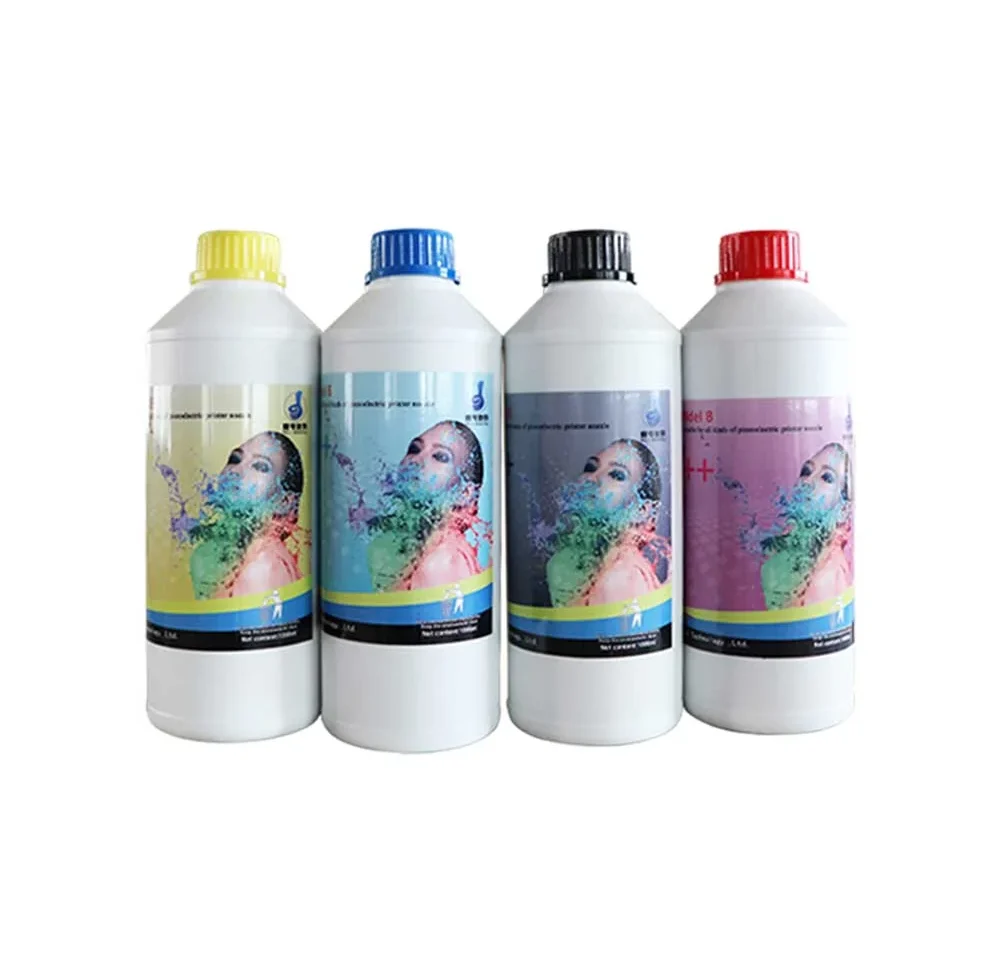
DTF ink is used for printing designs on white DTF Film. Common colors include cyan, magenta, yellow, black, and white, and standard bottles hold approximately 1 L. Compatible printheads, color combinations, and print parameters must be confirmed based on the specific equipment.
 Sublimation & Heat Transfer Consumables
Designing Equipment to Meet Actual Production Goals
DTF ink is used to print designs onto DTF DTF Film. After the film is printed, it must undergo thermoplastic powder application, powder shaking, drying, and heat pressing before the design can be transferred to apparel or other fabrics.The ink, film, powder, drying, and final heat pressing are all part of the same process; any mismatch in any of these steps may affect the final result.
Colors and Packaging
Common colors include Cyan (C), Magenta (M), Yellow (Y), Black (K), and White (W). The actual color combination must be confirmed based on the printer configuration, ink path, and white ink undercoating method; different devices may use different color arrangements. Standard bottle capacity is approximately 1 L; however, you should still verify the specific packaging, bottle opening, and equipment ink supply interface before ordering.
What to Consider When Matching Epson Printheads
Epson printheads are a common solution for DTF equipment, but “Epson printhead” is not a universal compatibility standard. Different printhead models, ink pathways, white ink circulation systems, printhead voltages, and RIP configurations all result in varying ink requirements.Before placing an order, provide the printer brand, specific printhead model, current ink, and ICC profile so that the equipment and ink suppliers can jointly confirm compatibility. It is not recommended to use one type of ink directly with another set of printheads without prior confirmation.
What to Do After Printing
There is no separate curing step after DTF ink printing is complete. The subsequent process involves printing the film, applying TPU Hot Melt Powder, shaking off excess powder and drying, followed by heat pressing for transfer.Drying and heat-pressing temperatures, times, and speeds should be adjusted according to the equipment, film, powder layer, and fabric; parameters from other factories should not be directly adopted as fixed processes for your own equipment.
- Check the test print to verify the nozzle, color, and white ink status.
- Sprinkle the powder evenly onto the film and remove any excess powder.
- Complete the drying process according to equipment specifications and verify that the powder layer is stable.
- Perform heat pressing and peel tests according to the customer’s equipment and fabric specifications.
Storage and Shelf Life
Ink should be kept sealed and protected from light, stored in an environment below 30°C (room temperature), and protected from high temperatures, freezing, dust, and moisture. The shelf life is typically indicated on the bottle label and by the batch number; under normal conditions, it can be stored for several years. However, storage conditions after opening, the integrity of the seal, and frequency of use may affect actual performance.When switching batches, retain a sample of the old batch and reprint the test image.
Troubleshooting Common Issues
- Faded colors:First check the nozzles, print test strips, color configuration, film, and powder layer; do not attribute the issue solely to the ink.
- Uneven white ink:Verify the white ink circulation, printhead maintenance, and print mode, and check the film and drying conditions.
- Insufficient adhesion after washing:Check the film, TPU Hot Melt Powder, drying, heat-pressing conditions, and fabric finishing in that order.
- Abnormal Results After Ink Replacement:Verify printhead compatibility, ink path cleanliness, and ICC settings; halt mass production if necessary.
When selecting compatible products, refer toDTF transfer films, DTF TPU Hot Melt Powders, andthe differences between DTF and dye-sublimation processes. For specific fabric compatibility, consultthe fabric guide.
Ink Replacement and Ink Path Management
Inks from different brands, batches, or color systems should not be mixed without prior verification. Before changing ink, verify printhead compatibility, ink path cleaning methods, and RIP settings to prevent residual ink from reacting with the new ink.Each time you restock, record the batch number on the bottle and the date of opening. Before using a new ink for the first time, print a test image to verify the condition of the nozzles, colors, and white ink before proceeding with bulk orders.
Equipment Information Provided Prior to Purchase
To confirm DTF ink compatibility, provide the printer brand, specific printhead model, color channels, white ink circulation method, commonly used films, and current ink types. Simply stating “uses Epson printheads” is insufficient to determine full compatibility, as different printhead structures and ink delivery systems have varying ink requirements.After confirming this information, determine the color combinations, package quantities, and restocking cycles.
Configured for stable mass production
- For use with DTF heat Transfer Machines
- Available in a variety of colors, including Cyan (C), Magenta (M), Yellow (Y), Black (K), and White (W)
- White ink is used for priming in the DTF process and can be selected as needed
- Used for printing designs on white ink DTF Films
Matching Processes to Material Properties
Expand Modules According to Production Line Requirements
Frequently Asked Questions About “Sublimation & Heat Transfer Consumables”
01 Are you a manufacturer or a trading company?
We are a manufacturer of printing equipment based in Dongguan, Guangdong. Founded in 2003, we handle all aspects of our business—from research and development to precision machining, assembly, and commissioning—in our own factory. Our equipment has been exported to 83 countries and regions.
02 How do I choose between sublimation drum transfer and digital printing?
Sublimation drum transfer is suitable for continuous mass production of synthetic fabrics, offering high design fidelity, consistent colors, and low unit costs; for small-batch orders with multiple designs, digital printing may be a better option. Send us your fabric and design, and we’ll provide recommendations based on a side-by-side comparison.
03 Can we produce a sample first to verify the process?
Sure. Please send us the fabric and design, and we’ll create a sample using the appropriate machine model. We’ll provide you with parameters such as temperature, pressure, and speed, along with a sample piece of fabric. Once you’ve confirmed the transfer results, we’ll finalize the machine model.
04 Can the web width, speed, and production capacity be customized?
Yes. The web width, speed, tension control, and unwinding, web guiding, and rewinding configurations can all be adjusted according to the fabric characteristics and production capacity goals.
05 What are the differences between cold peel, hot peel, and instant peel DTF Films?
The difference lies in the timing of peeling the film: for “cold peel,” you wait until the design has completely cooled before peeling; for “hot peel,” you peel while it’s still warm; and for “instant peel,” you peel immediately after pressing. Which method to choose depends on the type of film and the level of detail in the design.
06 How to Choose the Width and Thickness of DTF Film?
Select the width based on the printer’s maximum print width (common models are 300 mm and 600 mm), and select the thickness based on the design’s level of detail and the desired final texture; both can be customized.
07 How to Choose Between Ultrafine, Fine, Medium-Fine, and Coarse TPU Hot Melt Powder?
Ultra-fine powder has a smooth texture, making it ideal for intricate designs with many details and providing a softer feel; coarse powder is more cost-effective and suitable for large areas of solid color. Fine powder and medium-fine powder are the two most commonly used grades in everyday production.
08 What are the differences between the standard, high-concentration, and ultra-high-concentration versions of sublimation ink?
The three types differ in ink concentration: the higher the concentration, the less ink is used per unit area and the richer the color. For everyday production, use the standard version; if you’re looking for color saturation and ink savings, choose the high-concentration or ultra-high-concentration version.
09 How do you choose the weight of sublimation transfer paper?
The higher the grammage, the greater the ink absorption and the less likely the ink is to bleed, making it suitable for designs with high ink coverage and large blocks of color; lower grammage results in lower costs. Common grammages range from 70 to 100 g/m², and custom options are available upon request.
10 Why Is White Ink Used in DTF Printing?
First, a layer of white ink is applied to the bottom of the design to block the fabric’s natural color, which is why DTF can print vibrant, colorful designs even on dark-colored clothing.
11 Can consumables be customized? What is the minimum order quantity?
Customization is available. Width, length, thickness, grammage, capacity, and packaging specifications can all be customized to meet your needs; minimum order quantities and lead times vary by specification. Please send us the specifications you need, and we’ll confirm the details.
12 How should consumables be stored? Do they have an expiration date?
We recommend storing the product in a cool, dry place, away from direct sunlight and high temperatures. Use paper products as soon as possible after opening the package, and use ink as soon as possible after opening the container. Please contact us for specific shelf life and storage conditions.
Inquire about the detailed specifications for this device
Please provide us with the material, roll width, speed, and target production capacity, and our engineers will evaluate the equipment configuration and delivery time.
- One-on-One Engineer Evaluation
- Configuration Plan Based on Materials and Production Capacity
- We will respond within one business day
You can also contact us directly
- Email [email protected]
- Phone +86 13713137075
- WhatsApp +86 13713137075